Universe Today
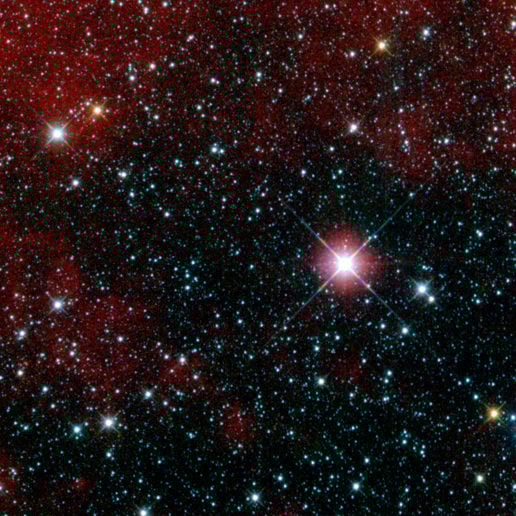
Caption: WISE First Light image. Image credit: NASA/JPL-Caltech/UCLA
"In many respects, the most important moment for a telescope is its first light," said Bill Irace, project manager for the Wide-field Infrared Survey Explorer (WISE) spacecraft, speaking at the 215th American Astronomical Society meeting. "And we are happy to be able to share WISE's first light image with you today." The image covers a patch of sky about three times larger than the full moon. An interstellar dust cloud shows in the upper left, and the bright object in the right-center is V 482 Carina, an old puffy, cool giant star. The image was taken with what will be WISE's standard 8.8 seconds of exposure time where it "stares" at a specific point in the sky. Ultimately, WISE will take millions of images to conduct an all sky survey in 10 months, before the frozen hydrogen that keeps the instrument cold evaporates away.
The exposure shows infrared light from three of WISE's four wavelength bands: Blue, green and red correspond to 3.4, 4.6, and 12 microns, respectively. WISE will search for millions of hidden objects, including asteroids, "failed" stars, powerful galaxies and brown dwarf stars too cool to emit light, including a potential brown dwarf that might be closer to Earth than Proxima Centauri. WISE data will also serve as navigation charts for other missions.
Irace and David Leisawitz from Goddard Space Flight Center said in about a month, the science team will release the first images from the first survey to the public. "Longer term, the astronomical community around the world has been looking forward to this," said Leisawitz, "as all of WISE's data will be released for anyone to use starting in April 2011, with the final release in March 2012. The data products include an atlas of images and catalog of individual objects."
Leisawitz said that magnificently and stunningly, WISE provides 400 times better angular resolution than the infrared instrument on the COBE spacecraft.
Irace divulged that this image was strictly an engineering image with no regard to the field of view. "We actually took about six images, but this one was the prettiest," he said. "We did not point at a particular point in the sky, and in fact we didn't know if we were going to be able to do it this fast, so this is basically a random image."
The science team believes the spacecraft will still be operational for 3 additional months following the 10 month prime mission, and are writing a proposal to NASA for funding to continue.
For a larger version of the image,
visit this NASA webpage.
Source: AAS press conference