Universe Today
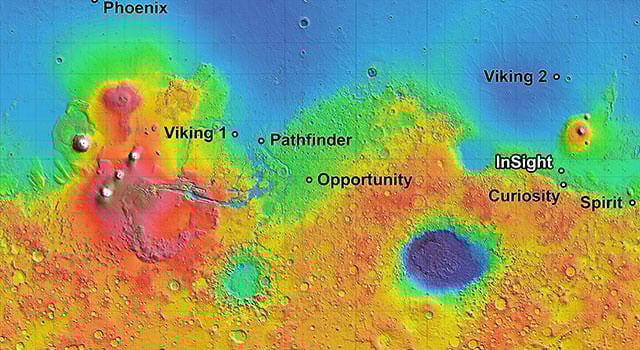
Where’s the best place to drill baby, drill on Mars – and not for oil but digging into Mars’ past? Apparently, a relatively level spot near the equator is the preferred spot. The 2016 InSight lander is the next mission to land on Mars and it will use a probe to hammer down 3-5 meters under the surface. NASA has now narrowed down the potential landing sites to just four from an original twenty-two proposed locations, and all four lie along the planet’s mid-section on the plains of Elysium Planitia.
"We picked four sites that look safest," said geologist Matt Golombek from the Jet Propulsion Laboratory. Golombek is leading the site-selection process for InSight. "They have mostly smooth terrain, few rocks and very little slope."
InSight stands for “Interior Exploration Using Seismic Investigations, Geodesy and Heat Transport” and it is scheduled to launch in March 2016 and land in September of that year. The mission will investigate processes that formed and shaped Mars and will help scientists better understand the evolution of our inner solar system's rocky planets, including Earth. It will also monitor the planet's current internal temperature and any seismology taking place.
So, unlike previous Mars landings, what is on the surface in the area matters little in the choice of a site except for safety considerations.
"This mission's science goals are not related to any specific location on Mars because we're studying the planet as a whole, down to its core," said Bruce Banerdt, InSight principal investigator. "Mission safety and survival are what drive our criteria for a landing site."
Elysium works well for the InSight mission because of two basic engineering constraints. One requirement is being close enough to the equator for the lander's solar array to have adequate power at all times of the year. Also, the elevation must be low enough to have sufficient atmosphere above the site for a safe landing. The spacecraft will use the atmosphere for deceleration during descent.
InSight also needs penetrable ground for its probe that will monitor heat coming from the planet's interior. This tool can penetrate through broken-up surface material or soil, but could be foiled by solid bedrock or large rocks. InSight also will deploy a seismometer on the surface and will use its radio for scientific measurements.
Images from the Mars Reconnaissance orbiter have been crucial in narrowing down the sites, and will continue to aid scientists and engineers in choosing the final site.
Golombek said that since considering what is below the surface is important to evaluate candidate landing sites, scientists also studied MRO images of large rocks near Martian craters formed by asteroid impacts. Impacts excavate rocks from the subsurface, so by looking in the area surrounding craters, the scientists could tell if the subsurface would have probe-blocking rocks lurking beneath the soil surface.
Each semifinalist site is an ellipse measuring 81 miles (130 kilometers) from east to west and 17 miles (27 kilometers) from north to south. Engineers calculate the spacecraft will have a 99-percent chance of landing within that ellipse, if targeted for the center. The team will select two or three finalists by the end of 2014, and make a final decision on InSight's destination by the end of 2015.