Universe Today
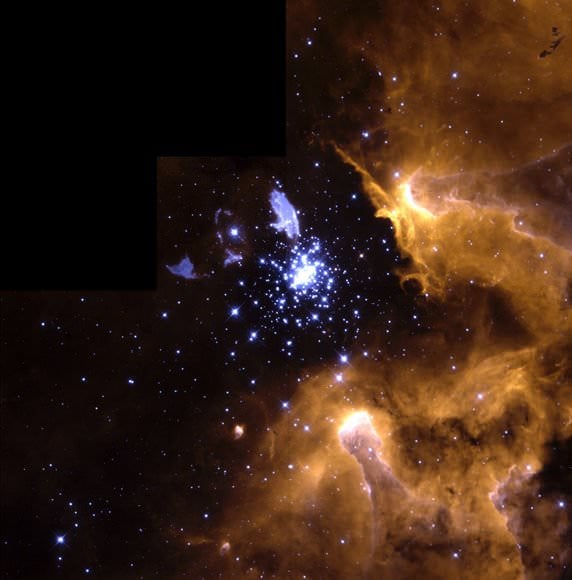
It's Wednesday (already?!) so that means its time for another "Where In The Universe" challenge to test your visual knowledge of the cosmos. This week's image was submitted by UT reader Rob Bowman, and Rob is hoping to stump everyone this week. Try to guess/name where in the Universe this image is from, and give yourself extra points if you can name the spacecraft responsible for the image. Make your guess and post a comment, but please no links to the answer. Check back sometime on Thursday to find the answer and see how you did. Good luck!
UPDATE: The answer has now been posted below.
Rob certainly chose wisely with this image, as almost everything about the life cycle of stars is right here. This is a giant galactic nebula, NGC 3603, taken with the Wide Field Planetary Camera 2 on board Hubble that was just returned back to Earth from the servicing mission. There is a lot going on in this image, as it captures various stages of the star life cycle in one single view. To the upper left of center is the evolved blue supergiant called Sher 25. The star has a unique circumstellar ring of glowing gas that is a galactic twin to the famous ring around the supernova 1987A.
The grayish-bluish color of the ring and the bipolar outflows (blobs to the upper right and lower left of the star) indicates the presence of processed (chemically enriched) material. Near the center of the view is a so-called starburst cluster dominated by young, hot Wolf-Rayet stars and early O-type stars.
A torrent of ionizing radiation and fast stellar winds from these massive stars has blown a large cavity around the cluster. The most spectacular evidence for the interaction of ionizing radiation with cold molecular-hydrogen cloud material are the giant gaseous pillars to the right of the cluster. These pillars are sculptured by the same physical processes as the famous pillars Hubble photographed in the M16 Eagle Nebula.
Dark clouds at the upper right are so-called Bok globules, which are probably in an earlier stage of star formation. To the lower left of the cluster are two compact, tadpole-shaped emission nebulae. Similar structures were found by Hubble in Orion, and have been interpreted as gas and dust evaporation from possibly protoplanetary disks (proplyds). This true-color picture was taken on March 5, 1999.
Thanks to Rob Bowman for submitting this image – particularly timely because of the Hubble Servicing mission that was completed last week.
Check back next week for another WITU Challenge!