Universe Today
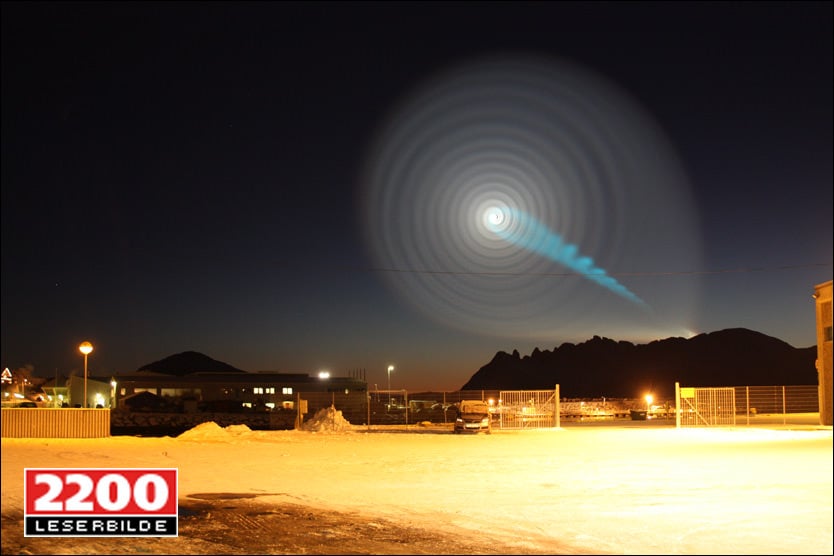
Just what created the big blue spiral in the sky over Norway in the early morning hours of Dec. 9, 2009? Time traveling Borgs? Psychedelic aliens? Most likely, it was something much more terrestrial and much more boring. Many reports say it was the failed launch of a Russian rocket, probably a Bulava ICBM, a problem-plagued Russian missile that reportedly had several test launches scheduled. Although Russian officials haven't confirmed this (and in fact one official denied there was any rocket launch in the area) an anonymous Russian military source said it actually was failed launch from a submarine in the White Sea early Wednesday morning.
UPDATE (Dec. 10): Russia has finally admitted a missile accident with the Bulava ICBM. This rocket already has failed six of 13 previous tests, according to the BBC, so Russia might have been a little embarrassed about it.
In what seems to confirm a rocket launch, yesterday, a message from NAVTEX was issued message warning airplanes not to fly, and ships not to sail in that area:
ZCZC FA79 031230 UTC DEC 09 COASTAL WARNING ARKHANGELSK 94 SOUTHERN PART WHITE SEA 1.ROCKET LAUNCHING 2300 07 DEC TO 0600 08 DEC 09 DC 0200 TO 0900 10 DEC 0100 TO 0900 NAVIGATION PROHIBITED IN AREA
Additionally, a researcher at the Tromsø Geophysical Observatory (where they observe auroras) Truls Lynne Hansen is certain that the light was caused by a missile launch. "The missile has probably come out of control and exploded," Hansen was quoted in the Barents Observer. "The peculiar spiral shaped light pattern comes from reflection of the sun in the leaking fuel."
Visible in the images and videos is the sunlight just beginning to peek over the horizon which would have back-lit the fuel.
Another launch on November 1 also caused strange light phenomenon in northern parts of Norway, although not as spectacular as the one today. It also caused speculation as to the cause, but it came from the launch of a Sineva missile from the nuclear submarine in the White Sea.
Doug Ellison from UnmannedSpaceflight.com has created a video (updated and improved from his earlier version we had in our previous article) showing the morphology of a tumbling rocket stage throwing out unspent fuel in two directions. "This is a set of rendered views using 3DS Max to produce a coarse simulation of what may have occurred to produce the beautiful formation in the sky over Norway earlier today," he said. "It is not an 'official' answer, though. It looks beautiful, but there's probably a fairly ordinary explanation."
Other explanations?
Here are just a few that were emailed to me today:
Aurora: Not likely. No aurora has ever taken on this shape.
Birkeland Current: Again, not likely. A Birkeland Current a magnetic field aligned current in the Earth’s magnetosphere which flows from the magnetotail towards the Earth on the dawn side and in the other direction on the dusk side of the magnetosphere. Birkeland currents often show filamentary, or twisted "rope-like" magnetic structure, and they create the aurora Borealis and Australis when they reach the upper atmosphere.
Poisk module: This Russian module undocked from the International Space Station yesterday, and a employee at Boeing said the module would have had unspent fuel which would have been released on reentry. However, the timing doesn't seem to be right as to when it would have burned up the in the atmosphere.
Projection: There has been some talk this was just a projection on the sky. However, the phenomenon was seen in a wide area, meaning such a projection would have to be huge. Again, not likely.
Sources: Barents Observer, Navtex