Universe Today
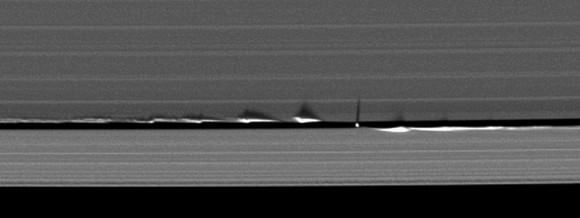
Cassini has imaged towering vertical structures in the planet’s otherwise flat rings that come from the gravitational effects of a small nearby moon. This is the first time these structures have been seen. They reach up over one kilometer high, and are visible now as the sun nears "high noon" directly overhead at the planet's equator, as Saturn approaches its equinox.
The search for ring material extending above and below Saturn’s ring plane has been a major goal of the imaging team during Cassini’s “Equinox Mission,” the two-year period containing the exact equinox. This novel illumination geometry, which occurs every half-Saturn-year, or about 15 Earth years, lowers the sun’s angle to the ring plane and causes out-of-plane structures to cast long shadows across the rings, making them easy to detect.
Images taken in recent weeks have demonstrated how small moons in very narrow gaps can have considerable and complex effects on the edges of their gaps, and that such moons can be smaller than previously believed.
The 8-kilometer-wide (5-mile) moon Daphnis orbits within the 42-kilometer-wide (26-mile) Keeler Gap in Saturn’s outer A ring, and its gravitational pull perturbs the orbits of the particles forming the gap’s edges. Earlier images have shown "waves" in the rings from Daphnis eccentric orbit.
But new images show the shadows of the vertical waves created by Daphnis cast onto the nearby ring. These characteristics match what was predicted by scientists.
Scientists have estimated, from the lengths of the shadows, wave heights that reach enormous distances above Saturn’s ring plane – as large as 1.5 kilometers (1 mile) -- making these waves twice as high as previously known vertical ring structures, and as much as 150 times as high as the rings are thick. The main rings -- named A, B and C -- are only about 10 meters (30 feet) thick.
“We thought that this vertical structure was pretty neat when we first saw it in our simulations,” said John Weiss, lead author of a paper reporting on these images. “But it’s a million times cooler to have your theory supported by such gorgeous images. It makes you suspect you might be doing something right.”
Click here to watch a movie of the vertical structures and waves in motion.
Also presented in the paper is a refinement to a theory used since the Voyager missions of the 1980s to infer the mass of gap-embedded moons based on how much the moons affect the surrounding ring material. The authors conclude that an embedded moon in a very narrow gap can have a smaller mass than that inferred by earlier techniques. One of the prime future goals of the imaging team is to scour the remaining gaps and divisions within the rings to search for the moons expected to be there. “It is one of those questions that have been nagging us since getting into orbit: ‘Why haven’t we yet seen a moon in every gap?’” said Carolyn Porco, lead for the Cassini imaging team. “We now think they may actually be there, only a lot smaller than we expected.”
Source: CICLOPS