Universe Today
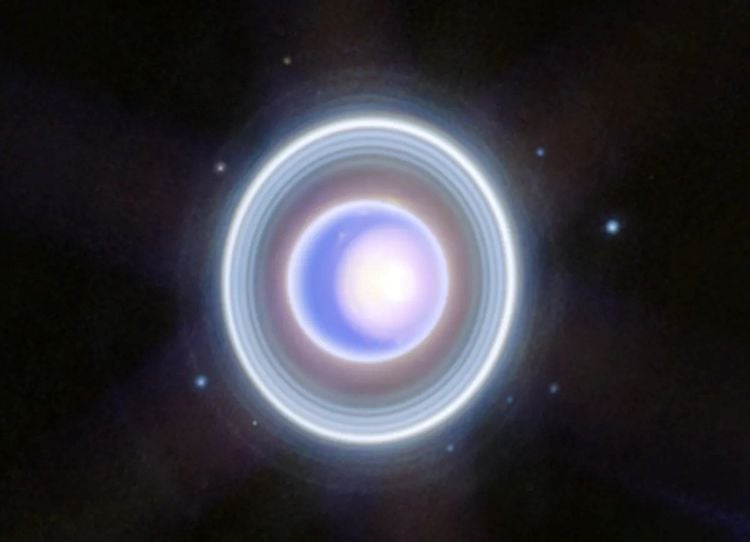
The ice giant Uranus is one of the most fascinating objects in the solar system, with its sideways rotation, intricate ring system, and unique family of moons. However, it is also one of the least explored objects in the solar system, owing to its extreme distance from the Sun. With NASA’s Voyager 2 spacecraft remaining as the only spacecraft to visit Uranus, scientists continue to design and envision mission concepts for returning to explore Uranus and its icy secrets.
Now, a lone researcher from might be one step closer to sending a mission back to Uranus, as they propose the CASMIUS (Coupled AtmosphereS and Magnetosphere Interactions of the Uranus System) in a study recently presented at the 57th Lunar and Planetary Science Conference. For the study, Dr. Hadi Madanian, who is a Research Scientist and founder of Earth and Planetary Exploration Sciences LLC (Epex Scientific), discusses how the CASMIUS mission concept could help unveil new insights into Uranus, including its interior composition, magnetic field structure, and composition of Uranus’ rings and many moons.
While the study doesn’t mention whether CASMIUS will be an orbiter mission or flyby (like Voyager 2), it does recommend using two spacecraft with different instruments that “provide stand-alone experiments and complement the other spacecraft measurements.” The study does an excellent job outlining potential launch and flight timelines to reach Uranus, including a launch in mid-2033 that would take approximately 9-10 years, mid-2034 that would take approximately 8-10 years, mid-2035 that would also take approximately 8-10 years, and a 2036 mission that would take approximately 10 years. Each timeline was based on the spacecraft change in velocity, officially called delta-V.
The study notes, “Understanding the complexities of the Uranus system opens a new window to understanding the solar system formation, planetary dynamo, and exoplanet research. It also furthers our knowledge of our home planet in critical areas such as geomagnetism and dynamo and can provide insights into extreme events such as the magnetic dipole reversal. As such, a flagship class mission to Uranus is a monumental endeavor with enabling science across disciplines and consequential findings that extends beyond the current century.”
As noted, NASA’s Voyager 2 continues to be the only spacecraft to visit Uranus and its family of moons, as the spacecraft made its famous flyby in late-January 1986, which consisted of collecting imagery and data from November 1985 to February 1986. Very little was known about Uranus and its moons prior to the Voyager 2 flyby, as images and data was limited to ground-based telescopes, revealing a blurry world due to its vast distance from Earth. As a result, Voyager 2 discovered 10 new moons, two new rings (there were nine known rings prior to the flyby), and measured Uranus’ sideways magnetic field. Scientists knew about Uranus’ sideways rotation since the mid-19th century, as astronomers observed how the moons orbited Uranus perpendicular to “normal” orbits.
Aside from CASMIUS, there are currently a plethora of proposed missions to explore Uranus and its many moons, with NASA’s Uranus Orbiter & Probe (UOP) mission arguably being the most significant, as it was named a high priority “Flagship” mission by NASA’s “Origins, Worlds, and Life: A Decadal Strategy for Planetary Science and Astrobiology 2023-2032”, and will have an orbiter and atmospheric probe. Examples of other proposed missions include China’s Tianwen-4, which is slated to be a Jupiter orbiter and Uranus flyby; and the European Space Agency’s MUSE (Mission to Uranus for Science and Exploration) mission concept, which mirrors NASA’s UOP mission with an orbiter and atmospheric probe.
How will CASMIUS potentially help explore Uranus and its ice giant secrets in the coming years and decades? Only time will tell, and this is why we science!
As always, keep doing science & keep looking up!