Universe Today
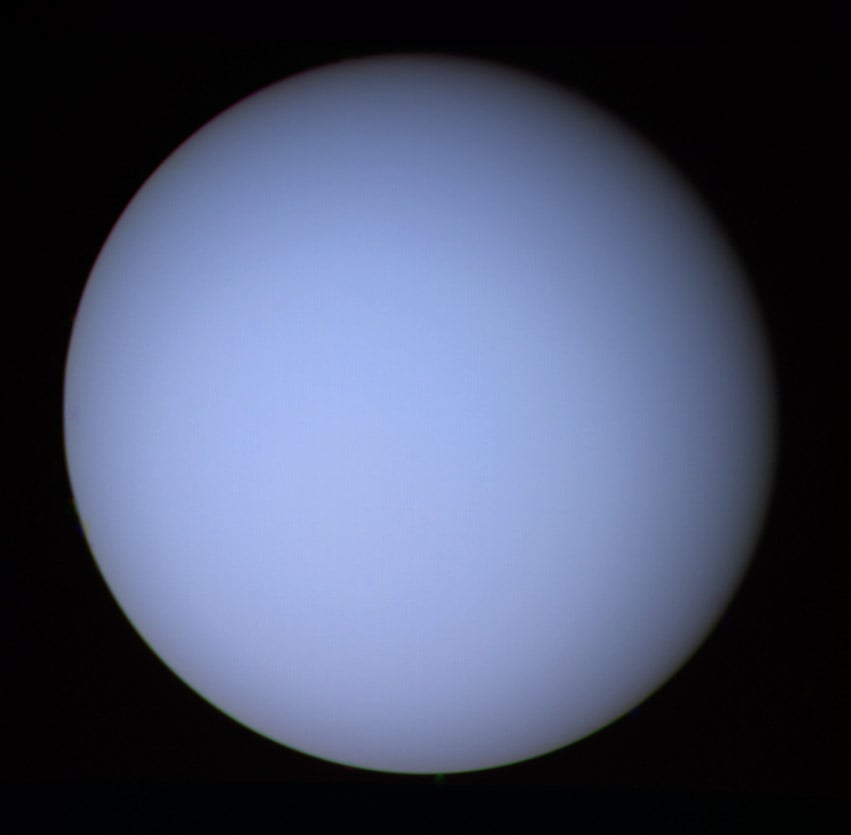
The following Uranus fact sheet is based on NASA's excellent planetary fact sheets. Uranus is the 7th planet from the Sun, and it requires a telescope to be able to see it.
Mass: 86.832 x 1024 kg Volume: 6,833 x 1010 km3 Average radius: 25,362 km Average diameter: 50,724 km Mean density: 1.270 g/cm3 Escape velocity: 21.3 km/s Surface gravity: 8.87 m/s2 Natural satellites: 27 Rings? - Yes Semimajor axis: 2,872,460,000 km Orbit period: 30,685.4 days Perihelion: 2,741,300,000 km Aphelion: 3,003,620,000 km Mean orbital velocity: 6.81 km/s Orbit inclination: 0.772° Orbit eccentricity: 0.0457 Sidereal rotation period: 17.24 hours Length of day: 17.24 hours Axial tilt: 97.77° Discovery: 13 March 1781 Minimum distance from Earth: 2,581,900,000 km Maximum distance from Earth: 3,157,300,000 km Maximum apparent diameter from Earth: 4.1 arc seconds Minimum apparent diameter from Earth: 3.3 arc seconds Maximum visual magnitude: 5.32
We've written many articles about Uranus for Universe Today. Here's an article about the atmosphere of Uranus, and here's an article about a blue ring around Uranus.
If you'd like more info on Uranus, check out Hubblesite's News Releases about Uranus. And here's a link to the NASA's Solar System Exploration Guide to Uranus.
We've also recorded an entire episode of Astronomy Cast just about Uranus. Listen here, Episode 62: Uranus.