Universe Today
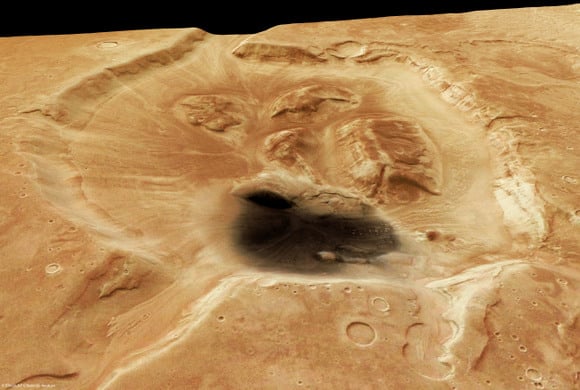
The Mars Express Spacecraft captured several images of an unusual crater in the Mamers Valles area on Mars with its High-Resolution Stereo Camera (HRSC). The crater is at the end of the long, winding valley, and contains a remarkable dark area. Scientists are not certain whether the dark colored material could have formed in-situ or if it may have been transported by the wind. Some of the structures shown here are thought to be ice-rich debris flows, and they show some resemblance to block glaciers seen on Earth.
Scientists call a region like Mamers Valles ‘fretted terrain’ because it shows numerous deep and wide labyrinth-like valleys and circular depressions which often show structures formed by flowing liquid on their even floors.
The patches of rock at the center of the depression are thought to be remnants of rock that were detached from the sides of the depression and transported to the center.
This false color image shows the differences in elevation. The image was made using elevation data obtained from an HRSC-derived high-resolution Digital Terrain Model (DTM), which is used to create elevation maps on Mars. Elevation data from the DTM has been color-coded and combined with the HRSC image so that elevation data and the image itself are displayed in a single scene.
The depression is approximately 30 km wide and 1400 m deep. It lies at the south-eastern end of Mamers Valles. The data was obtained on August 5, 2006 with a ground resolution of approximately 14 m/pixel.
The images are centered at approximately 39° north and 17° east on the planet. The valley of Mamers Valles is approximately 1000 km long, running along the boundary between the northern lowlands and southern highlands in the region of Deuteronilus Mensae.
Original News Source:
ESA