Universe Today
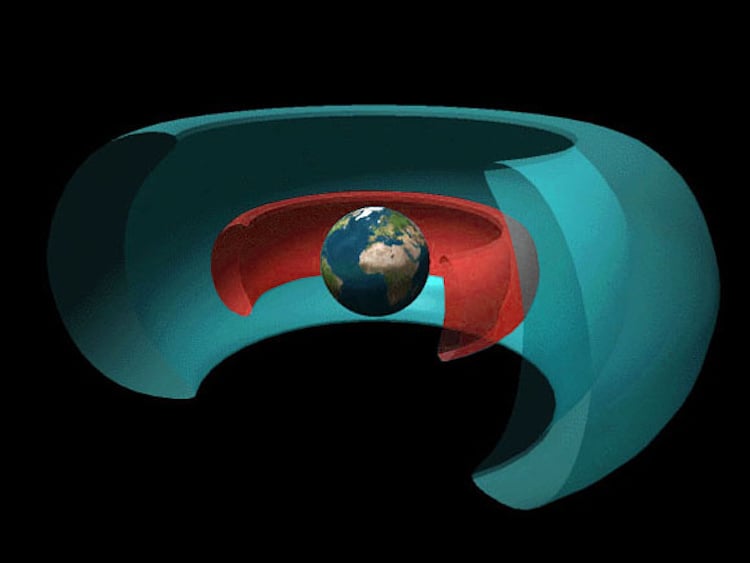
Picture a vast invisible doughnut wrapped around a planet, filled with electrons and protons hurtling around at extraordinary speeds. That's a radiation belt, and if your planet has a magnetic field strong enough to trap particles from the solar wind, chances are it has one.
Earth has two of them, named after the physicist James Van Allen who discovered them in 1958. Jupiter has some of the most powerful in the Solar System along with Saturn, Uranus and Neptune too. Even some brown dwarfs, the mysterious objects too massive to be planets but too small to ignite as stars, appear to have them.
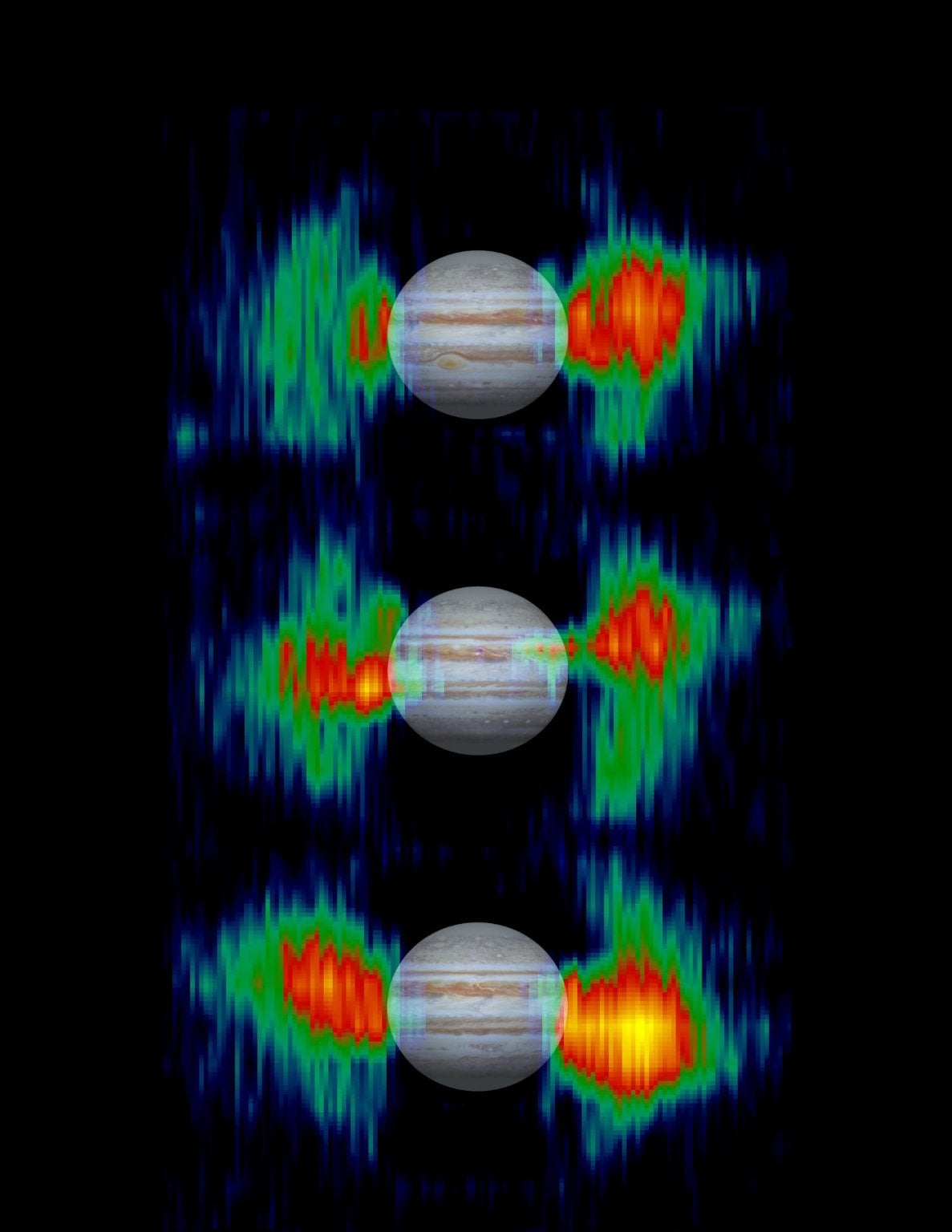 Jupiter's variable radiation belts (Credit : NASA JPL)
For decades, scientists have understood the basic mechanics. Radiation belts don't generate their own particles, they harvest them from the solar wind, the constant stream of charged particles flowing outward from a star. What the belts do is accelerate those particles to extraordinary speeds, pumping energy into them through complex interactions with the planet's magnetic field. Exactly how, and crucially how much, has been harder to pin down. Now, Adnane Osmane, Associate Professor of Space Physics at the University of Helsinki, has built a model that answers the second question with elegant simplicity. The model has just one variable, the strength of the planet's surface magnetic field. Feed that in, and the model tells you the maximum energy the radiation belt can give to a particle.
The key insight is that the process has a natural brake. As a radiation belt accelerates particles, those particles release energy of their own. Once the magnetic field exceeds a certain strength, this energy release cancels out the acceleration so the belt effectively hits a ceiling it cannot push through. Beyond that point, a stronger magnetic field doesn't produce more energetic particles. It simply can't.
The upper energy limit works out at roughly 7 teraelectronvolts, more than a trillion times the energy carried by a single photon of visible light. For context, that's comparable to the energies achieved by the Large Hadron Collider, the most powerful particle accelerator humans have ever built. Nature, it turns out, has been running similar experiments for billions of years.
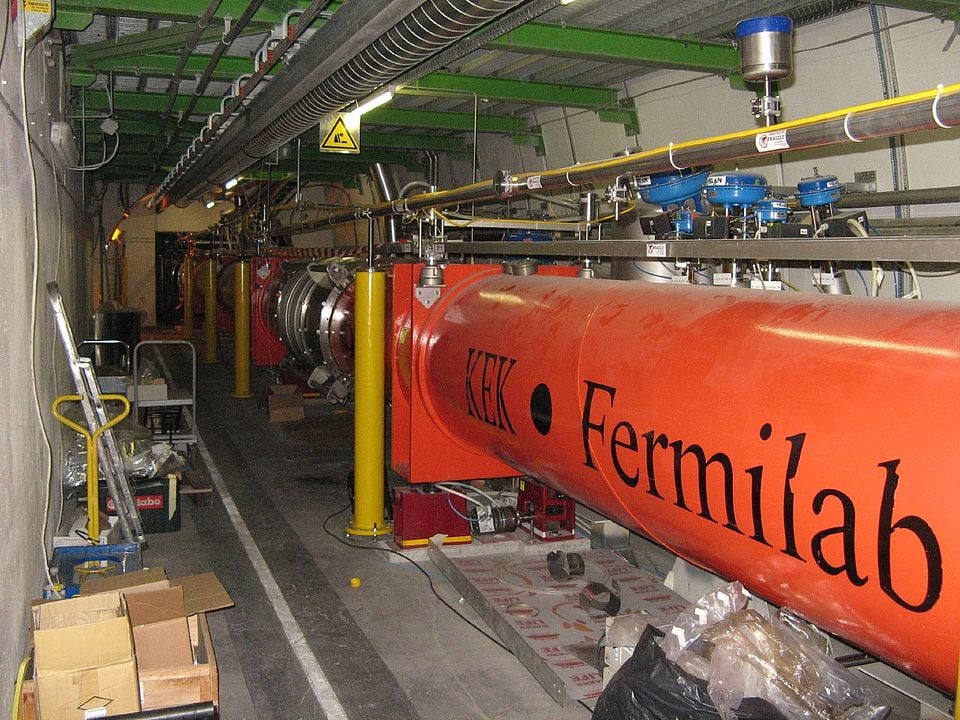 A section of the Large Hadron Collider, a particle accelerator that produces comparable energy levels as the Earth's Van Allen Belts (Credit : Gamsiz)
The model can be applied to exoplanets too and suggests which radio wavelengths might betray the presence of a radiation belt, and therefore a magnetic field, around worlds we can't yet visit. That matters enormously for the search for life. A planetary magnetic field is thought to be one of the key ingredients for habitability, shielding a world's surface from harmful radiation and helping to hold an atmosphere in place over geological timescales.
Source : A new model defines an upper limit to planetary radiation belt intensity