Universe Today
A few weeks ago, researchers announced the discovery of a "dark flow" of invisible matter tugging at distant galaxy clusters at the edge of the universe. Now comes more evidence of unseen and unknown forces in the cosmos, but this time its closer to home. A group of researchers have discovered that our particular part of the Universe — out to a distance of 400 million light years — is not expanding uniformly in all directions as expected. To be exact, the expansion is faster in one half of the sky than in the other. "It's as if, in addition to the expansion, our 'neighbourhood' in the Universe has an extra kick in a certain direction," says Mike Hudson from the University of Waterloo in Ontario, Canada. "We expected the expansion to become more uniform on increasingly larger scales, but that's not what we found." If confirmed, their findings will result in a new understanding of the origin of structure in the universe and possible revisions to the standard cosmological model.
Hudson and two other scientists have been conducting research on large-scale cosmic flows and the general expansion of the universe. This expansion increases the distances between galaxies steadily with time, and is called the Hubble flow. Deviations of the velocity of galaxies from the overall Hubble flow is called the "peculiar velocity." By examining the peculiar velocities of clusters and superclusters scientists can obtain estimates of local mass concentrations that may be responsible for causing any deviations from the Hubble flow.
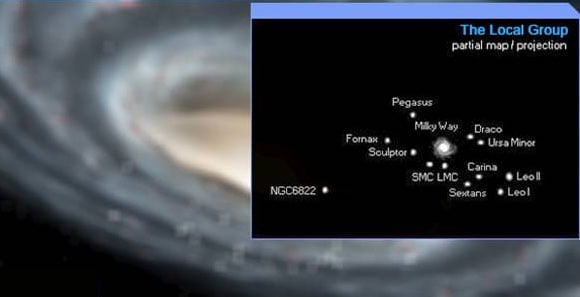
In particular, these researchers were attempting to address a longstanding question about the origin of the approximately 600 km/s peculiar velocity of the Local Group of galaxies, with respect to the Cosmic Microwave Background.
Using several different surveys they discovered that about 50% of the Local Group’s motion is faster than anticipated. To produce this motion, they believe there must be large unseen and unknown structures in the universe. They write, "The large value of the residual motion implies that there are significant velocities generated by very-large scale structures," and the structures lie beyond the Local Group.
Brian McNamara, a University Research Chair in UW's department of physics and astronomy, says Hudson is finding that much of the matter in the nearby universe moves as an ensemble with a surprisingly high speed. "If the work he and others are doing is confirmed, it will require a major revision in the way we think the universe came into being and how it evolved."
Hudson and his colleagues have submitted a paper to the Royal Astronomical Society, and a preprint version is available [here.
Sources: arXiv, University of Waterloo](http://lanl.arxiv.org/abs/0809.4041)