Universe Today
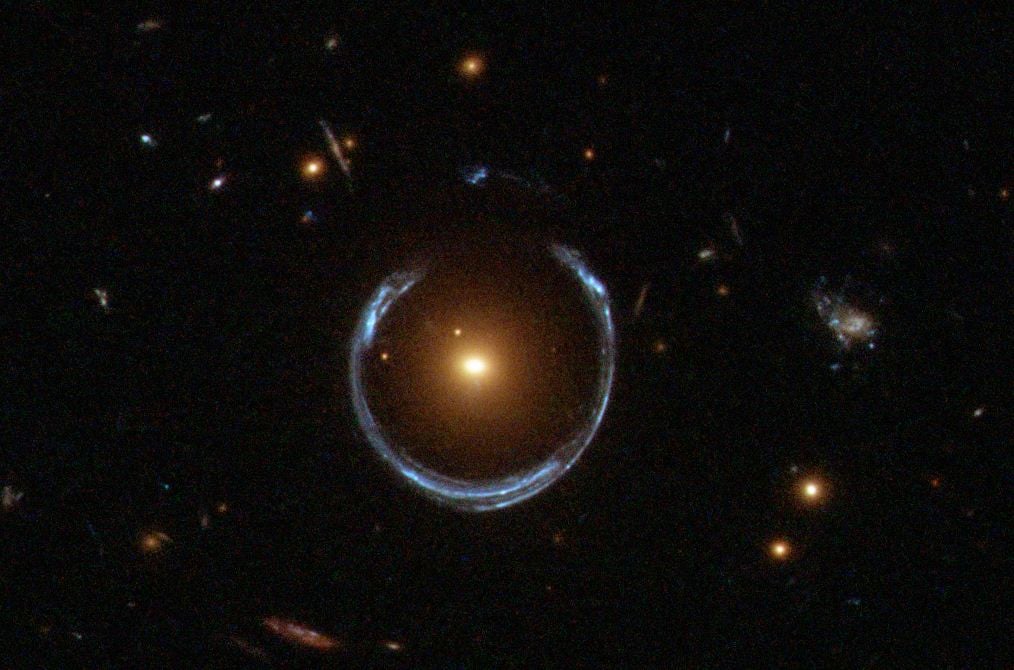
Imagine holding a wine glass up to a candle (of course I had to pour a glass to try this.) The curved glass bends and distorts the flame, stretching it into arcs and rings of light. Now scale that up to the size of a galaxy, replace the glass with a trillion solar masses of matter, and the candle with an entire galaxy billions of light years away. What you get is one of the most beautiful and scientifically powerful phenomena in all of astronomy, a gravitational lens.
Einstein's general theory of relativity tells us that mass warps the fabric of space itself. Light, following that curved space, bends around massive objects like galaxies and galaxy clusters. When the alignment is just right, the result is extraordinary, background galaxies appear stretched into glowing arcs, or smeared into perfect rings known as Einstein rings. These are not tricks of the eye. They are the universe bending light around corners.
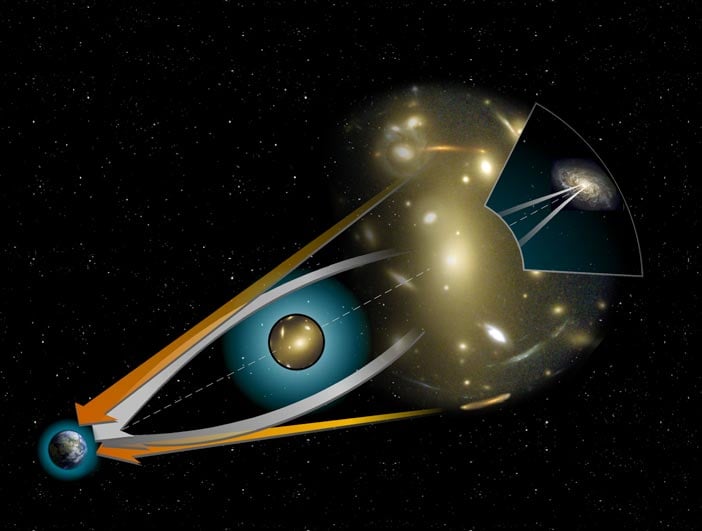 Einstein rings and other gravitational lens images form through the bending light around a massive object from a distant source. The orange arrows show the apparent position of the background source. The white arrows show the path of the light from the true position of the source
Now the European Space Agency's Euclid telescope that has already transforming our understanding of the universe, has released a new dataset of unprecedented scale, and scientists need help searching it. The Space Warps citizen science project, hosted on the Zooniverse platform, is inviting members of the public to join professional astronomers in hunting for gravitational lenses hidden within Euclid's first full year of observations.
I have a soft spot for citizen science. My first experience of it was SETI@home, a project that let people donate their computer's idle time to help search for signals from extraterrestrial intelligence. It ran as a screensaver on my desktop, and the idea that my machine might be the one to detect an alien civilisation while I made a cup of tea felt genuinely thrilling. That project showed the world what distributed human effort could achieve. Space Warps carries the same spirit but this time, the target is gravitational lenses rather than little green men.
Euclid has surveyed roughly 72 million galaxies in this data release, around 30 times larger than its initial dataset. Artificial intelligence has already pre-selected around 300,000 candidate images for closer inspection, but the human eye remains uniquely good at spotting the subtle, irregular arcs that signal a gravitational lens. Scientists hope to find more than 10,000 new lenses from this search alone, that’s more than have been discovered in the entire history of astronomy. When the team analysed just 0.04% of the available data, they found 500 lenses, most of them never seen before.
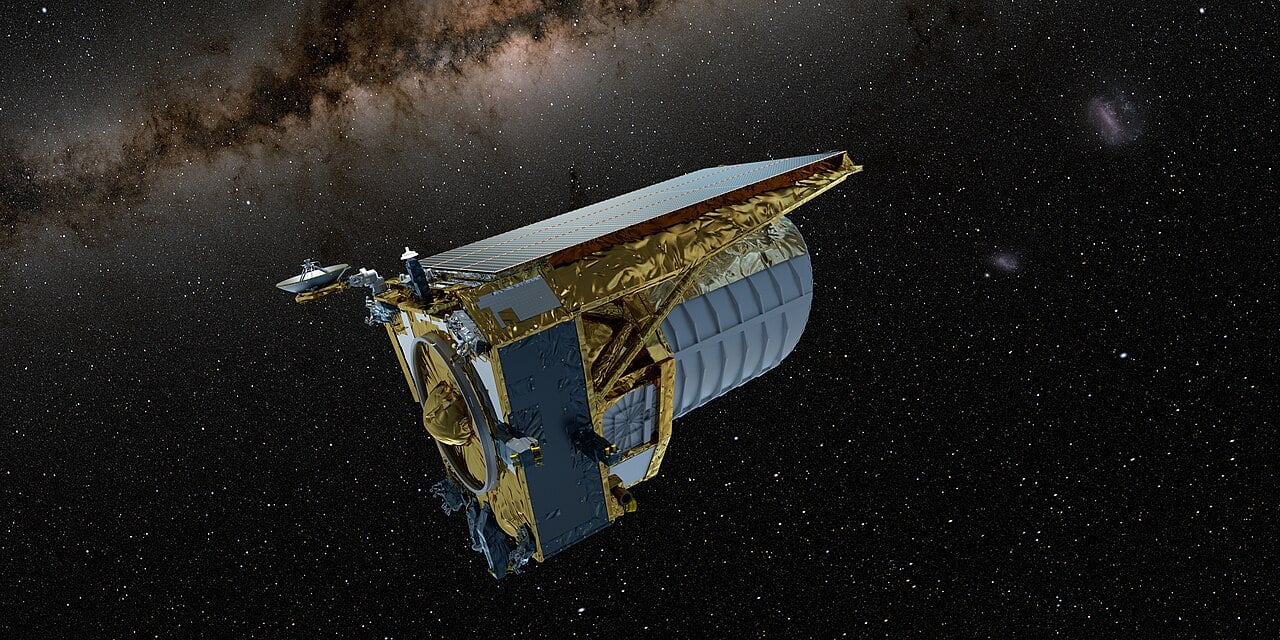 Artist impression of the Euclid mission in space (Credit : ESA)
Gravitational lenses act as natural weighing scales for galaxies, measuring the total mass of everything they contain including the dark matter that neither emits nor reflects light. By cataloguing thousands of these systems across different distances and epochs, scientists can trace how structures grew and how dark energy has driven the accelerating expansion of the universe.
You don't need a telescope or a physics degree to take part. Just a curiosity about the universe and a willingness to look. To learn more about the project, click here.
Source : Space Warps – Euclid DR1