Universe Today

Here's something worth thinking about next time you glance up at the sky on a clear day. The Sun is spinning, not uniformly, like a solid ball, but the equator races around in roughly 25 days, while the poles take closer to 35. It's called differential rotation, and it's one of the more peculiar features of our nearest star.
For decades, physicists had a neat theory about what happens to that rotation as a star ages. Stars gradually shed rotational speed over billions of years, bleeding it away through stellar winds. The thinking went that this slowdown would eventually reorganise the flows of hot gas deep inside, flipping the pattern entirely, making the poles spin faster than the equator. Anti-solar differential rotation, as it became known, was confidently predicted by theoretical models for 45 years. But there is just one niggling problem. It’s never been observed!
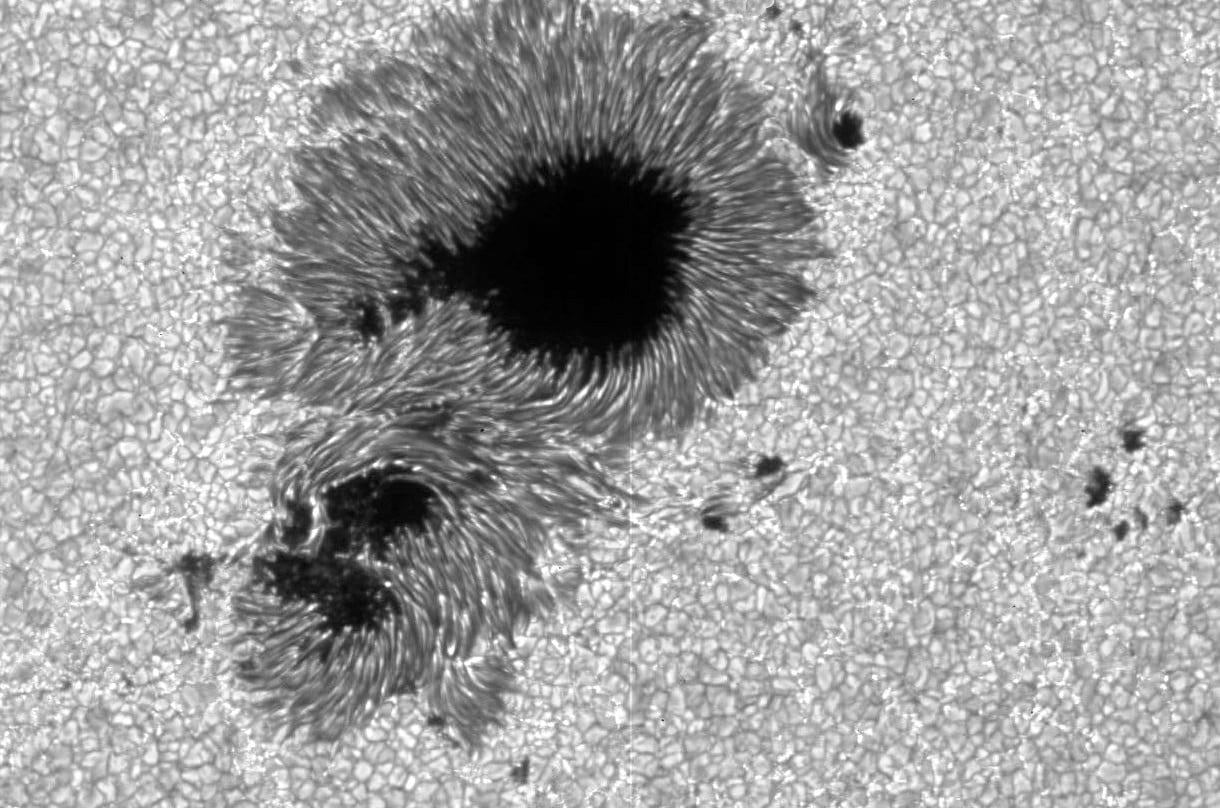 The surface of sun revealing granules and sunspots (size around 20'000km) which can be used to determine the local rotation speed of the Sun (Credit : NASA/JAXA)
Astronomers searching for stars exhibiting this flipped rotation pattern came up negative, time and again. The models said it should be everywhere. Observations found nothing. It was the kind of stubborn discrepancy that quietly gnaws at the edges of a scientific field for years.
Now, a team at Nagoya University in Japan think they know why and the answer comes down to something those earlier models were simply too crude to capture.
The researchers used Fugaku, Japan's most powerful supercomputer, to simulate the interiors of solar type stars at extraordinary resolution. Each simulated star was divided into 5.4 billion individual grid points, tracking the behaviour of hot gas and magnetic fields simultaneously. Previous simulations had used far lower resolution and at that lower resolution, the magnetic fields inside the star effectively vanished from the calculations, dismissed as insignificant background noise.
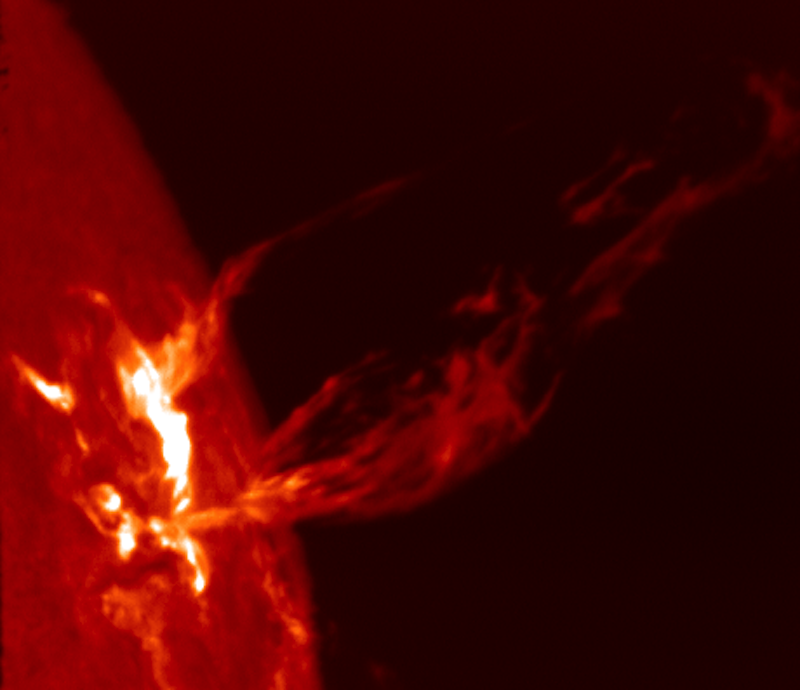 The magnetic field of the Sun is driving this filament eruption (Credit : NOAA)
At higher resolution, the magnetic fields stayed strong, and strong magnetic fields, working alongside the turbulent churning of hot gas inside the star, were enough to prevent the rotation flip entirely. The equator kept its lead over the poles, regardless of how slowly the star was spinning.
"So even though stars do slow down, the switch doesn't happen because magnetic fields, which previous simulations missed, prevent it" - Professor Hideyuki Hotta, one of the lead researchers on the study published in Nature Astronomy.
A better understanding of how rotation and magnetic fields interact inside stars could help unlock one of solar physics' most enduring puzzles; why the Sun's sunspot activity follows an 11 year cycle. It could also sharpen predictions about how a star's magnetic activity evolves over billions of years, which in turn affects whether any planets orbiting it remain suitable for life.
There's something quietly profound about this result. The Sun has been spinning this way for 4.6 billion years, and if this research is right, it will keep spinning this way for billions more, the same patient, lopsided rotation, equator always slightly ahead of the poles, held in place by magnetic fields threading through its interior like invisible scaffolding (you can tell I’ve been renovating my house with an analogy like that) Sometimes the universe turns out to be more constant and more reliable, than our theories gave it credit for.