Universe Today
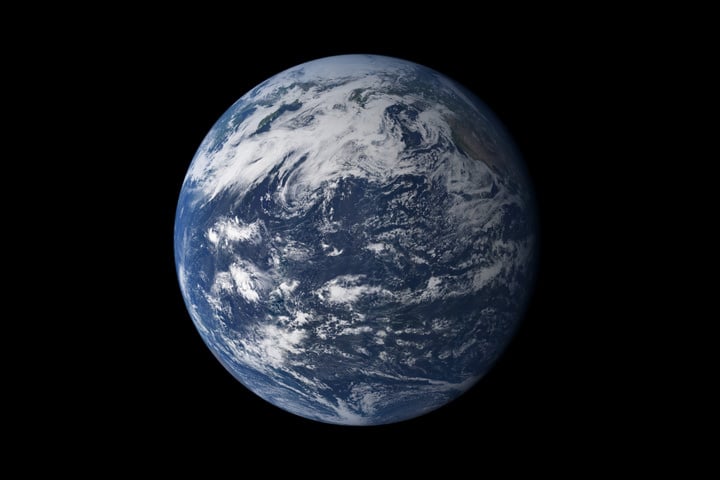
Despite recent news of potential habitable exoplanets and amazing images of Mars and the Saturn system returned from visiting spacecraft, the ol’ home planet is still about the most gorgeous-looking planetary body out there. We first saw it as a whole “blue marble” when the Apollo astronauts sent back pictures while circling the Moon, and it has been said that the original “Blue Marble” image taken by the Apollo 17 crew has been one of the most viewed and most influential images ever. But truth be told, that “Blue Marble” really wasn’t all that blue (see the original below). However, this new look at the home world shows how prevalent water really is. This composite image is based largely on observations from the Moderate Resolution Imaging Spectroradiometer (MODIS) on NASA’s Terra satellite.
It sure is pretty.
According to the NASA Earth Observatory website, Earth’s water content is about 1.39 billion cubic kilometers (331 million cubic miles), with the bulk of it, about 96.5%, being in the global oceans. As for the rest, approximately 1.7% is stored in the polar icecaps, glaciers, and permanent snow, and another 1.7% is stored in groundwater, lakes, rivers, streams, and soil. Only a thousandth of 1% of the water on Earth exists as water vapor in the atmosphere.
Here’s the original “Blue Marble,” the view of the Earth as seen by the Apollo 17 crew traveling toward the moon. This translunar coast photograph extends from the Mediterranean Sea area to the Antarctica south polar ice cap. This is the first time the Apollo trajectory made it possible to photograph the south polar ice cap. Almost the entire coastline of Africa is clearly visible. The Arabian Peninsula can be seen at the northeastern edge of Africa. The large island off the coast of Africa is Madagascar. The Asian mainland is on the horizon toward the northeast.
For larger versions of the top image, see NASA Earth Observatory's website, and this link for the Apollo 17 version, NASA also has versions of the Blue Marble compiled from various satellites in 2001 and 2002.