Universe Today
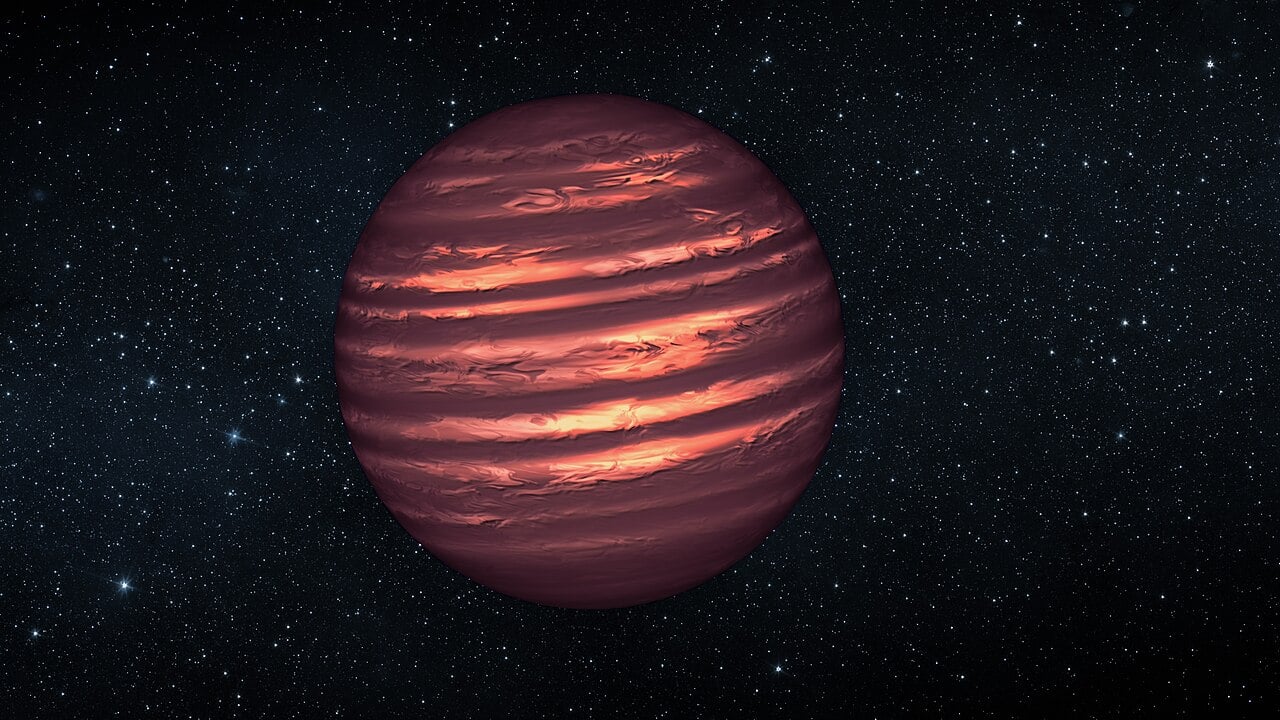
Imagine a star that’s been shining steadily for decades, and then suddenly it dims to just 3% of its normal brightness. Not for a few days or weeks, but for more than nine months. That’s exactly what happened to ASASSN-24fw, a star sitting 3,200 light years away in the constellation Monoceros.
For astronomers watching, this was deeply puzzling. Stars don’t normally behave like this. When something passes in front of a star such as a planet, for instance, the dimming typically lasts days, perhaps weeks at most. But this event stretched on for nearly 200 days, making it one of the longest stellar dimming events ever observed.
The researchers suspected something unusual was blocking the star’s light, but what? New findings published in Monthly Notices of the Royal Astronomical Society suggest they’ve cracked the case, and the answer is wonderfully exotic.
The most likely explanation is a brown dwarf surrounded by absolutely enormous rings, creating a structure rather like Saturn’s rings, but on a vastly bigger scale. Think of it as a giant saucer passing in front of the star, gradually blocking its light.
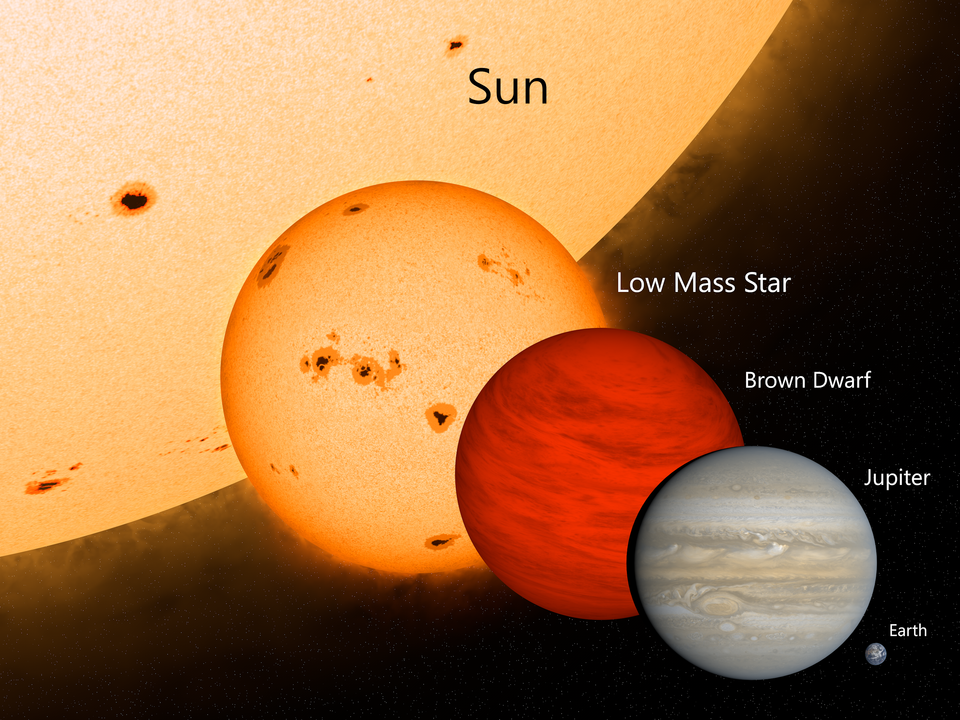 A comparison of a Brown Dwarf to our Sun, a low mass red dwarf star, Jupiter, and the Earth (Credit : NASA)
Brown dwarfs occupy an odd middle ground in the stellar family tree. They’re too massive to be planets, they have more than enough bulk to dominate their surroundings gravitationally but they’re not quite massive enough to sustain the nuclear fusion reactions that power true stars. They’re sometimes called “failed stars,” though that seems rather unfair. They’re fascinating objects in their own right.
The alternative explanation is that the object might be a super Jupiter, a gas giant planet that’s grown absolutely enormous, pushing the boundaries between what we’d call a planet and what we’d call a brown dwarf. Either way, the ring system doing the blocking is staggering in size. It extends about 0.17 astronomical units from the central object, which is roughly half the distance between our Sun and Mercury. That’s colossal.
Dr Sarang Shah from the Inter-University Centre for Astronomy and Astrophysics in India, who led the research, explains that the dimming happened gradually because the outer parts of the rings are thin. The dramatic drop in brightness only became obvious when the denser, thicker regions passed directly in front of the star.
The team’s analysis suggests the companion object has a mass at least three times that of Jupiter. They also discovered something unexpected about the star itself, it appears to have a circumstellar environment close to it, possibly remnants from planetary collisions. This is unusual for a star that’s probably more than a billion years old, you’d expect such debris to have cleared away by now.
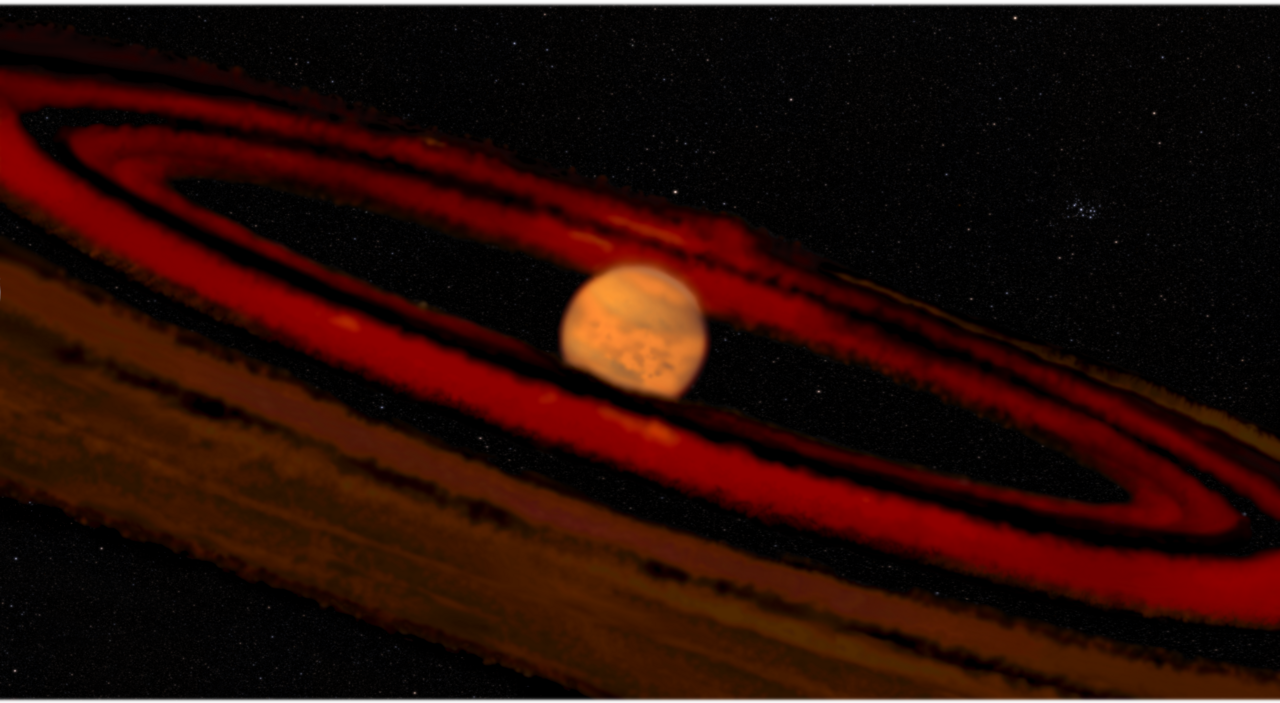 Artist impression of a brown dwarf with rings (Credit : NASA/Jonathan Holden)
As a bonus discovery, the researchers also found that ASASSN-24fw has a red dwarf star in its neighbourhood. Sometimes you go looking for one mystery and stumble across several.
Large ring systems are expected around massive objects, but they’re fiendishly difficult to observe directly. This rare dimming event gives astronomers a chance to study such a system in remarkable detail, essentially using the star’s own light as a backlight to illuminate the structure passing in front of it.
The researchers are now hoping to use heavyweight telescopes like the Very Large Telescope in Chile and the James Webb Space Telescope to gather more data about this system. They want to understand how structures like this form and evolve, and what they can tell us about planetary formation in general.
Source : Unseen planet or brown dwarf may have hidden 'rare' fading star