Universe Today
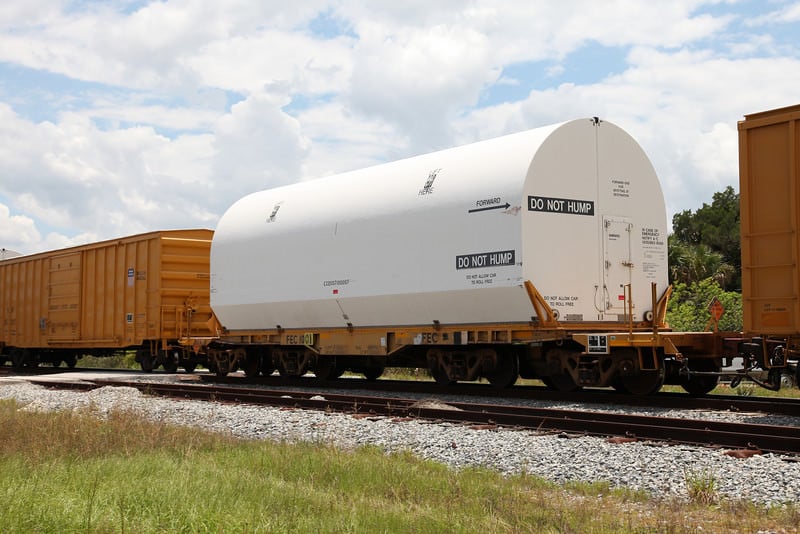
Another end-of-an-era event heralding the conclusion of the space shuttle program: the final set of space shuttle solid rocket booster segments arrived at the Kennedy Space Center on Thursday, May 27, 2010. The segments were carried on railway cars from the ATK factory in Utah where the boosters are built. The last part of the trip from Jacksonville, Florida included passenger cars carrying NASA personnel and ATK officials, including astronaut Mike Massimino, shuttle launch director Mike Leinbach, and the "voice" of NASA TV, George Diller. The train stopped across the Indian River from KSC where the tracks lead to the Vehicle Assembly Building.
The boosters will be stacked in the VAB for a possible rescue mission, or perhaps, even one last add-on flight for space shuttle Atlantis.
The SRB segments are designated for STS-335, the Launch-On-Need mission that would be flown if the last scheduled shuttle flight -- STS-134, now scheduled for launch in late November -- would encounter a problem. Or, if Congress allows, another shuttle mission using the ready-to-go shuttle could be added. U.S. Sen. Bill Nelson told President Obama in a letter this week that he intended to request funding for the extra mission. NASA hopes to get a go-ahead for the flight, which would become the STS-135 mission, by late June. If approved, the likely launch date would be sometime in the summer of 2011.
NASA's Associate Administrator for Space Operations Bill Gerstenmaier said at a news conference this week that if the additional flight were approved, a Soyuz would be readied as a rescue vehicle, and the shuttle crew would be smaller, probably 4 crew members. The crew could take safe harbor at the International Space Station, if needed, until the rescue Soyuz arrived. The shuttle could bring extra supplies and hardware to the ISS.
Veteran astronaut Mike Massimino told a Florida television station crew that he hopes for an additional shuttle mission. “I think we have to be optimistic,” Massimino said. “There are just too many people around the country and the world who are so supportive of our program.”
ATK laid off 1,300 of their 5,000 person workforce because of shutting down production of the boosters, but the company is hoping to be part of NASA's future spaceflight plans.
“There's quite a bit of uncertainty,” said ATK KSC Deputy Director Ted Shaffner. “The direction is very cloudy from our politicians and NASA is struggling with what direction we do take.”
More images from the event:
And I know someone is going to comment on the "Do Not Hump" sign on the railcar. What it means is that the contents of the railcar are delicate enough that the car should not be 'humped,' which is a method to sort freight cars by rolling them down a hill instead of using a locomotive engine to move the cars. Obviously, NASA and ATK don't want the SRB segments to go rolling down a hill. Find out more about humping here.
Sources: Florida Today, CFNews 13