Universe Today
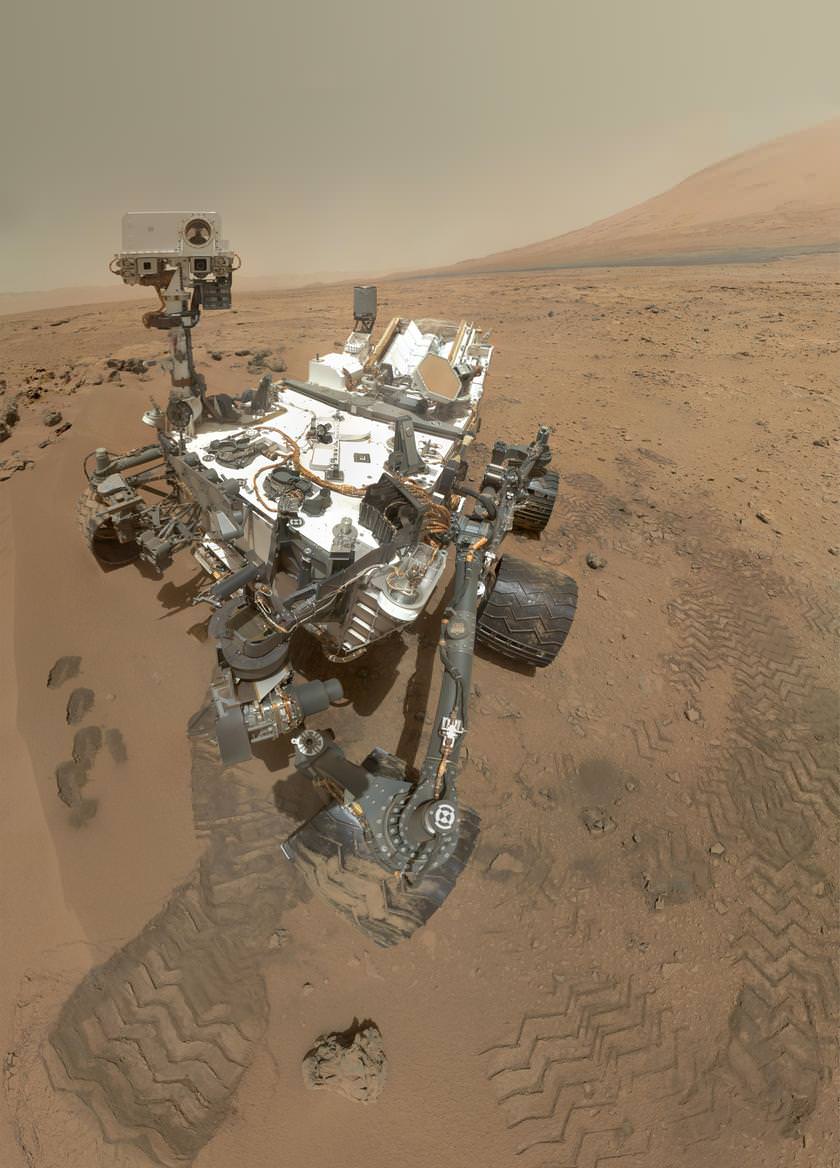
The Curiosity rover self portrait. Credit: NASA/JPL-Caltech/Malin Space Science Systems
OK, we thought the low-resolution
self-portrait from yesterday
was great... but here's the real goods: a monster, high-resolution awesome mosaic of 55 images taken by the Mars Hand Lens Imager (MAHLI), showing the rover at its spot in Gale Crater -- called Rocknest -- with the base of Gale Crater's 5-kilometer- (3-mile-) high mountain, Aeolis Mons or Mount Sharp, rising in the background. The images were taken on Sol 84 (Oct. 31, 2012), and sent to Earth today. In the foreground, four scoop scars can be seen in the regolith in front of the rover. As we mentioned about the previous MAHLI mosaic, the arm was moved for each of the 55 images, so the arm and the camera doesn't show up, just like any photographer behind the camera (or their arms) isn't visible in a photograph.
You can get access to the full resolution version
at this link.
It's amazing.
But that's not all...
NASA says that self-portraits like this one document the state of the rover and allow mission engineers to track changes over time, such as dust accumulation and wheel wear. Due to its location on the end of the robotic arm, only MAHLI (among the rover's 17 cameras) is able to image some parts of the craft, including the port-side wheels.
Emily Lakdawalla at the Planetary Blog
talks about the projection issue, where the wheel closest to the front looks big and distorted. That's a factor of the camera angle and Emily mentions a discussion of this is taking place by the image wizards over at
Unmanned Spaceflight
, if you want to see the various ways to deal with this issue.
Emily also points out how the rover photographed itself photographing itself -- due to the reflective surfaces on the turret, so
check out her analysis.
You can always see the raw images coming in from Curiosity
at this NASA website.
But the other cool thing is that another whole set of images was taken from a slightly different angle, which means only one thing: 3-D! Here's
Stu Atkinson's
first quick attempt:
There will surely be some refinements of the 3-D version, but enjoy this one for now!