Universe Today
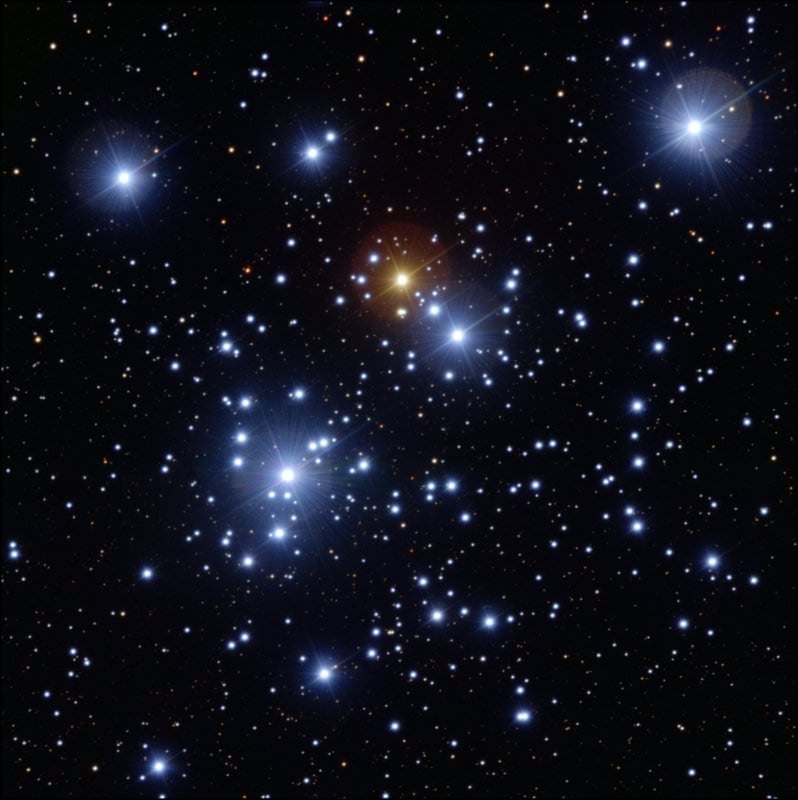
Nothing in my jewelry box compares to the Kappa Crucis Cluster, also known as NGC 4755 or simply the “Jewel Box.” This object is just bright enough to be seen with the unaided eye, but a combination of images taken by three exceptional telescopes, the Very Large Telescope, the 2.2-meter telescope at the La Silla observatory and the Hubble Space Telescope, has allowed the stunning Jewel Box star cluster to be seen in a whole new light. Above is the image from ESO' Very Large Telescope, which zooms in for a close look at the cluster itself. This new image is one of the best ever taken of this cluster from the ground, taken with an exposure time of just 5 seconds.
The Hubble Space Telescope can capture light of shorter wavelengths than ground-based telescopes can, and this new HST image of the core of the cluster represents the first comprehensive far ultraviolet to near-infrared image of an open galactic cluster. It was created from images taken through seven filters, allowing viewers to see details never seen before. It was taken near the end of the long life of the Wide Field Planetary Camera 2, Hubble’s workhorse camera up until the recent Servicing Mission, when it was removed and brought back to Earth, and replaced with an new and improved version. Several very bright, pale blue supergiant stars, a solitary ruby-red supergiant and a variety of other brilliantly colored stars are visible in the Hubble image, as well as many much fainter ones. The intriguing colors of many of the stars result from their differing intensities at different ultraviolet wavelengths.
A new image taken with the Wide Field Imager (WFI) on the MPG/ESO 2.2-metre telescope at ESO’s La Silla Observatory in Chile shows the cluster and its rich surroundings in all their multicolored glory. The large field of view of the WFI shows a vast number of stars. Many are located behind the dusty clouds of the Milky Way and therefore appear red.
Star clusters are among the most fascinating objects in the sky. Open clusters such as NGC 4755 typically contain anything from a few to thousands of stars that are loosely bound together by gravity. Because the stars all formed together from the same cloud of gas and dust their ages and chemical makeup are similar, which makes them ideal laboratories for studying how stars evolve.
Source: ESO