Universe Today
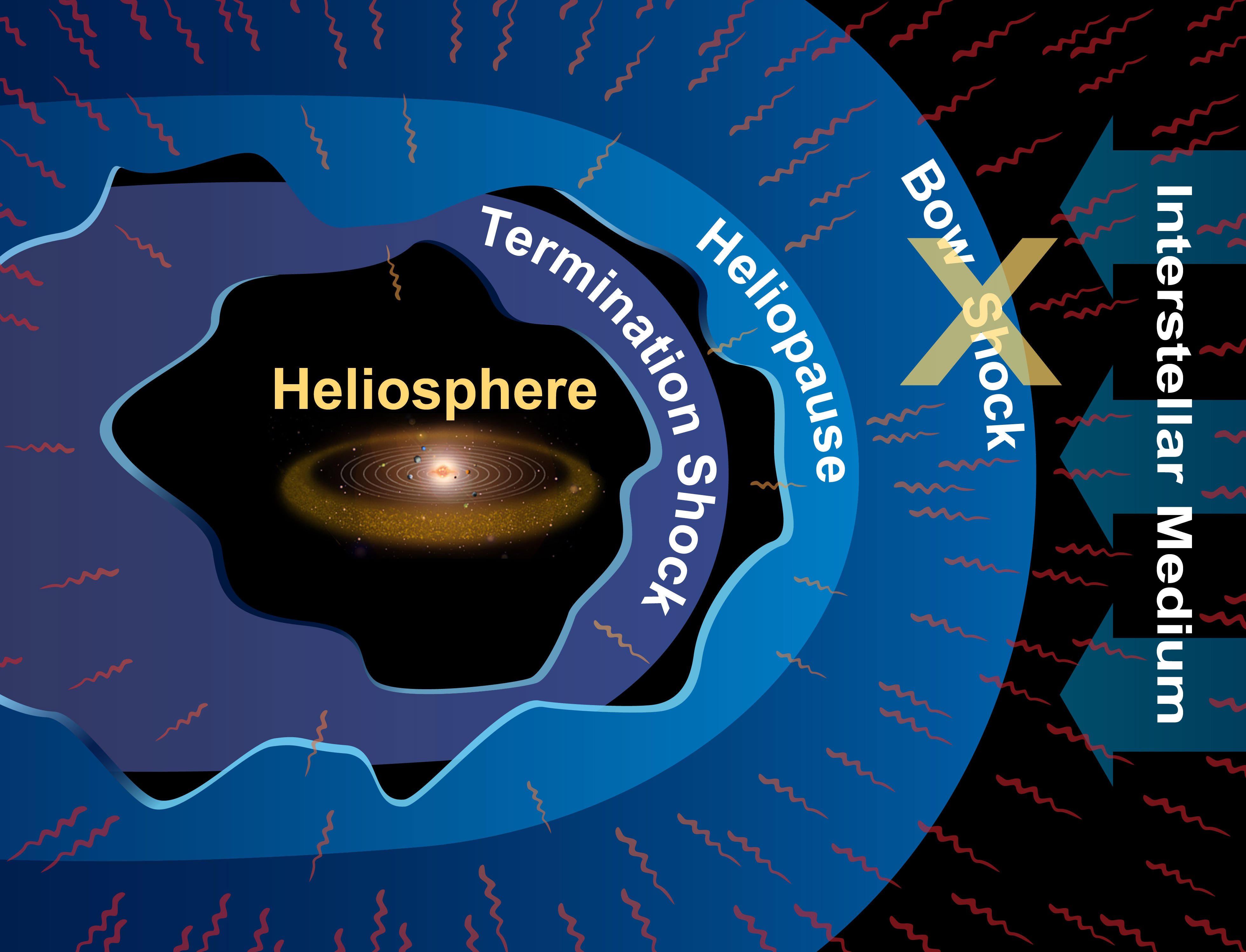
For years, scientists have thought a bow "shock" formed ahead of our solar system’s heliosphere as it moved through interstellar space – similar to the sonic boom made by a jet breaking the sound barrier. But new data from NASA's Interstellar Boundary Explorer (IBEX) shows that our system and its heliosphere move through space too slowly to form a bow shock, and therefore does not exist. Instead there is a more gentle ‘wave.’
"While bow shocks certainly exist ahead of many other stars, we're finding that our Sun's interaction doesn't reach the critical threshold to form a shock,” said Dr. David McComas, principal investigator of the IBEX mission, “so a wave is a more accurate depiction of what's happening ahead of our heliosphere — much like the wave made by the bow of a boat as it glides through the water."
From IBEX data, McComas and his team were able to make refinements in relative speed of our system, as well as finding more information about the local interstellar magnetic field strength. IBEX data have shown that the heliosphere actually moves through the local interstellar cloud at about 52,000 miles per hour, roughly 7,000 miles per hour slower than previously thought. That is slow enough to create more of a bow "wave" than a shock.
Another influence is the magnetic pressure in the interstellar medium. IBEX data, as well as earlier Voyager observations, show that the magnetic field is stronger in the interstellar medium requiring even faster speeds to produce a bow shock. Combined, both factors now point to the conclusion that a bow shock is highly unlikely.
This new finding perhaps correlates with earlier investigations by the CLUSTER mission, which found the bow shock was remarkably thin.
The IBEX team combined its data with analytical calculations and modeling and simulations to determine the conditions necessary for creating a bow shock. Two independent global models — one from a group in Huntsville, Ala., and another from Moscow — correlated with the analytical findings.
Their paper was published today in the journal Science.
How does this new finding change our understanding of our heliosphere?
"It's too early to say exactly what this new data means for our heliosphere,” McComas said. “Decades of research have explored scenarios that included a bow shock. That research now has to be redone using the latest data. Already, we know there are likely implications for how galactic cosmic rays propagate around and enter the solar system, which is relevant for human space travel."
Source: SwRI