Universe Today
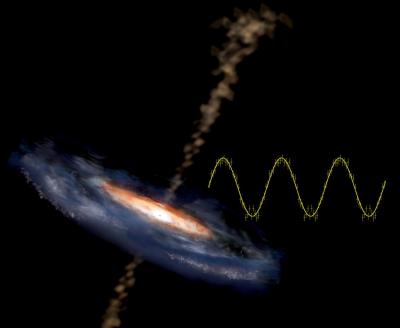
Sorry, couldn't resist that title. Astronomers studying black holes are able to "see" them due to the fact that the gas getting sucked in gets extremely hot and emits X-rays. These X-ray pulses are commonly seen among smaller black holes, but until now, had not been detected from super-massive black holes. But astronomers using the XMM Newton X-ray satellite have discovered a strong X-ray pulse emitting from a giant black hole in a galaxy 500 million light years from Earth, created by gas being sucked in by gravity. "Scientists have been looking for such behaviour for the past 20 years and our discovery helps us begin to understand more about the activity around such black holes as they grow," said Dr. Marek Gierlinski from Durham University. Gierlinski and his colleagues say this finding is the "missing link" between small and super-massive black holes.
The astronomers were looking at the center of the galaxy REJ1034+396 galaxy and found that X-rays are being emitted as a regular signal from the super-massive black hole. They say the frequency of the pulse is related to the size of the black hole. "Such signals are a well known feature of smaller black holes in our Galaxy when gas is pulled from a companion star," said Gierlinski. "The really interesting thing is that we have now established a link between these light-weight black holes and those millions of times as heavy as our Sun."
The scientists hope future research will tell them why some super-massive black holes show this behavior while others do not. Most galaxies, including the Milky Way, are believed to contain super-massive black holes at their centers.
The researchers, who publish their findings in the journal Nature on September 18, say their discovery will increase the understanding of how gas behaves before falling on to a black hole as it feeds and develops.
Source: Durham University