Universe Today
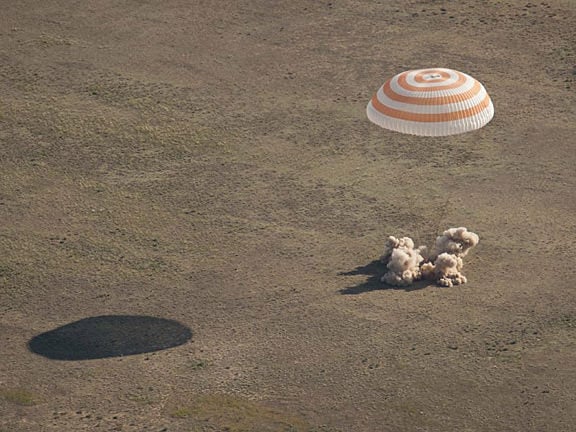
Three members of the Expedition 26 crew landed safely in their Soyuz spacecraft early Wednesday, but their replacements might not launch until mid-April, a delay of a couple of weeks. Commander Scott Kelly and Russian Flight Engineers Alexander Kaleri and Oleg Skripochka landed with no problems in the cold and snow of Kazakhstan, concluding their five-month stay aboard the International Space Station. But meanwhile, the Russian Soyuz TMA-21 is experiencing a problem with the communications system, and the new crew was scheduled to launch on March 29. But the launch may be delayed until after the April 12th 50th anniversary of Yuri Gagarin’s first space flight.
Roskosmos director Anatoly Perminov said technicians were working on a faulty transistor, and if the launch doesn’t take place by about April 9, they would likely be postponed until after the anniversary celebration of the first human to orbit Earth.
The delay could increase concerns about relying solely on Russia for rides to the ISS.
The new crew half of the Expedition 27 crew consists of NASA astronaut Ron Garan and Russian cosmonauts Andrei Borisenko and Alexander Samokutayev. Remaining on board the ISS are Dmitry Kondratyev, now commander and Flight Engineers Catherine Coleman (NASA) and Paolo Nespoli (ESA).
The Expedition 26 trio undocked from the ISS at 12:27 a.m. EDT from the station's Poisk module, and landed at 3:54 a.m. (1:54 p.m. local time) at a site northeast of the town of Arkalyk.
Working in frigid temperatures, Russian recovery teams were on hand to help the crew exit the Soyuz and adjust to gravity. Kaleri and Skripochka will return to the Gagarin Cosmonaut Training Center in Star City, outside of Moscow, while Kelly will fly directly home to Houston.
The three returning crewmembers have been in space since Oct. 8, 2010 when they launched aboard the Soyuz TMA-01M spacecraft from the Baikonur Cosmodrome in Kazakhstan, spending 159 days in space. During their mission, the Expedition 25 and 26 crew members worked on more than 150 microgravity experiments in human research; biology and biotechnology; physical and materials sciences; technology development; and Earth and space sciences.