Universe Today
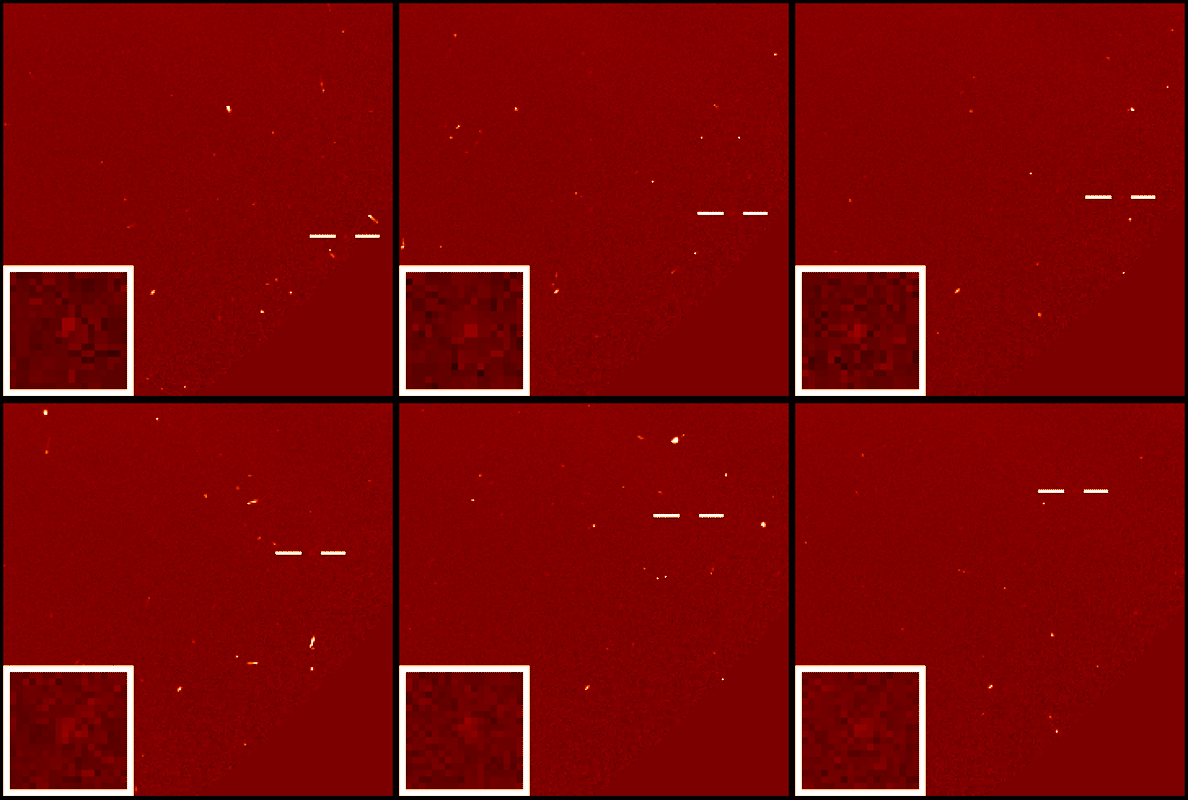
On June 25th, the ESA/NASA SOHO spacecraft discovered its 1,500th comet, making it more successful than all other comet discoverers throughout history, combined. But wait a minute, SOHO is the Solar and Heliospheric Observatory, designed to study solar physics. What’s it doing looking for comets? SOHO just happens to have a great vantage point to see comets as they approach the sun. Since its orbit is situated between the Sun and Earth, it has a unique view of the regions close to the sun that we can rarely see from Earth. But SOHO’s comet-finding success is just an added benefit to the extraordinary revelations this spacecraft has provided in its 13 years in space, observing the Sun and the near-Sun environment. “Catching the enormous total of comets has been an unplanned bonus,†said Bernhard Fleck, ESA SOHO Project Scientist.
About 85% of SOHO’s comet discoveries are fragments from a once-great comet that split apart in a death plunge around the Sun, probably many centuries ago. The fragments are known as the Kreutz group, which now pass within 1.5 million km of the Sun’s surface when they return from deep space.
That’s pretty close in celestial terms, and from Earth, we can only see those regions close to the Sun during an eclipse.
But that also puts them within sight of SOHO’s electronic eyes. Images of the comets are captured by the Large Angle and Spectrometric Coronograph (LASCO), one of 12 instruments on board.
Of course, LASCO itself does not make the detections; that task falls to an open group of highly-skilled volunteers who scan the data as soon as it is downloaded to Earth. Once SOHO transmits to Earth, the data can be on the Internet and ready for analysis within 15 minutes.
Enthusiasts from all over the world look at each individual image for a tiny moving speck that could be a comet. When someone believes they have found one, they submit their results to Karl Battams at the Naval Research Laboratory, Washington DC, who checks all of SOHO’s findings before submitting them to the Minor Planet Center, where the comet is cataloged and its orbit calculated.
From this mission, and with the public’s help, scientists have learned a great deal about comets.
“This is allowing us to see how comets die,†says Battams. When a comet constantly circles the Sun, it loses a little more ice each time, until it eventually falls to pieces, leaving a long trail of fragments. Thanks to SOHO, astronomers now have a plethora of images showing this process. “It’s a unique data set and could not have been achieved in any other way,†says Battams.
Most of the comet fragments are eventually destroyed when they get close enough to the Sun, evaporated by the Sun’s radiation.
Interested in helping search for SOHO’s comets? Visit the Sungrazing comets page.
Original News Source:
ESA