Universe Today
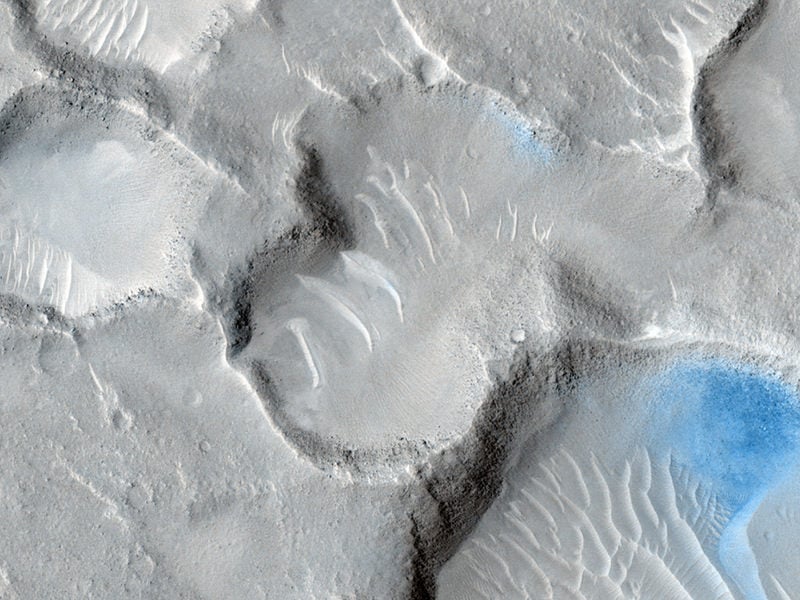
Since its disappearance in December 2003, scientists and citizen scientists alike have continued the search for Europe’s Beagle 2 lander which likely crashed on Mars. Its disappearance is a mystery and if the spacecraft could be located, it might be possible to discover what went wrong.
The Mars Reconnaissance Orbiter’s powerful HiRISE camera has been regularly taking high-resolution images of the Isidis basin region where the Beagle 2 lander was supposed to touch down.
“Nothing resembling the Beagle lander has been seen in any of the HiRISE images, although we aren't sure that they've been thoroughly searched,” said HiRISE Principal Investigator Alfred McEwen, writing on the HiRISE website.
So, join in the search and take a look!
Above is the 12th such image taken by HiRISE.
McEwen said the easiest thing to spot would be the bright parachute -- if it actually deployed. Remember how HiRISE was able to find the parachutes at the MER landing sites, and even capture the Phoenix lander descending on its parachute? The Beagle 2’s parachute would be a good clue to search for.
(As we reported earlier, the HiRISE team will attempt to image the Mars Science Laboratory during its descent to Mars’ surface in August, as it did for Phoenix.)
Dust should not be a problem as far as hiding the lander or parachutes, McEwen said. “Dust deposition over the past eight years probably would not disguise the bright feature over equatorial regions of Mars,” he said noting that the parachutes are still easy to spot at the MER and Pathfinder landing sites. “At high latitudes the brightness patterns are reset each winter by the seasonal deposits of carbon-dioxide and dust, as seen at the Phoenix landing site.”
All contact with Beagle 2 was lost after its separation from the Mars Express spacecraft, just six days before atmospheric entry. McEwen said the lack of telemetry on its way to the surface means there is little information about where the spacecraft may have landed on the surface, but searching in the region where it was expected to land is a good place to start.
You can download high-resolution version of this images here.
For an idea of what the Beagle 2 hardware might look like, see this web page.