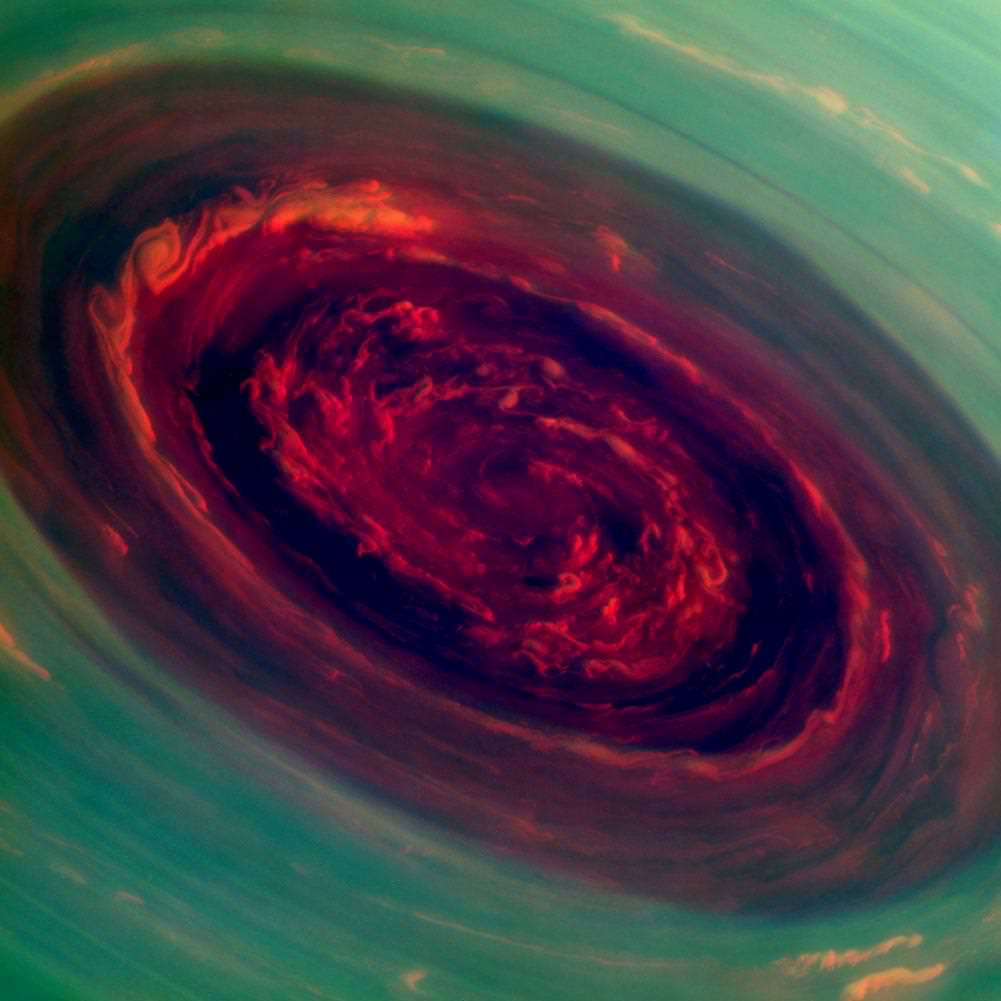
Real Images From NASA Show the 'Cosmos' as a Space-Time Odyssey

With the

premiere of the revamped "Cosmos" series

, NASA used this opportunity to showcase the imagery and missions that are such a big part of our explorations of the Universe, live-Tweeting during the show:

As seen on #Cosmos: @NASAVoyager, which is currently exploring interstellar space http://t.co/yJyDulqbEZpic.twitter.com/zcmea6d6ms — NASA (@NASA)

The

Goddard Space Flight Center Flickr page

featured a gallery of images from the cosmos, many which are part of the "Cosmos" series. See a sampling of great images below:

[caption id="attachment_110207" align="aligncenter" width="580"]

This mosaic of M31 merges 330 individual images taken by the Ultraviolet/Optical Telescope aboard NASA's Swift spacecraft. It is the highest-resolution image of the galaxy ever recorded in the ultraviolet. The image shows a region 200,000 light-years wide and 100,000 light-years high (100 arcminutes by 50 arcminutes).

Credit: NASA/Swift/Stefan Immler (GSFC) and Erin Grand (UMCP)[/caption]

[caption id="attachment_110208" align="aligncenter" width="540"]

NASA's IMAGE Spacecraft View of Aurora Australis from Space. Credit: NASA.[/caption]

[caption id="attachment_110209" align="aligncenter" width="580"]

On August 31, 2012 a long filament of solar material that had been hovering in the sun's atmosphere, the corona, erupted out into space at 4:36 p.m. EDT. The coronal mass ejection, or CME, traveled at over 900 miles per second. The CME did not travel directly toward Earth, but did connect with Earth's magnetic environment, or magnetosphere, causing aurora to appear on the night of Monday, September 3.

The image above includes an image of Earth to show the size of the CME compared to the size of Earth.

Credit: NASA/GSFC/SDO[/caption]

[caption id="attachment_110200" align="aligncenter" width="568"]

This planetary nebula's simple, graceful appearance is thought to be due to perspective: our view from Earth looking straight into what is actually a barrel-shaped cloud of gas shrugged off by a dying central star. Hot blue gas near the energizing central star gives way to progressively cooler green and yellow gas at greater distances with the coolest red gas along the outer boundary. Credit: NASA/Hubble Heritage Team[/caption]

[caption id="attachment_110210" align="aligncenter" width="580"]

This Hubble photo is of a small portion of one of the largest seen star-birth regions in the galaxy, the Carina Nebula. Towers of cool hydrogen laced with dust rise from the wall of the nebula. Credit: NASA, ESA, and M. Livio and the Hubble 20th Anniversary Team (STScI).[/caption]

See more great images at

Goddard's Flickr page

, and

NASA's Image of the Day gallery.

Nancy Atkinson

Nancy Atkinson

Nancy Atkinson is a space journalist and author with a passion for telling the stories of people involved in space exploration and astronomy. She is currently retired from daily writing, but worked at Universe Today for 20 years as a writer and editor. She also contributed articles to The Planetary Society, Ad Astra (National Space Society), New Scientist and many other online outlets.

Her 2019 book, "Eight Years to the Moon: The History of the Apollo Missions,” shares the untold stories of engineers and scientists who worked behind the scenes to make the Apollo program so successful, despite the daunting odds against it. Her first book “Incredible Stories From Space: A Behind-the-Scenes Look at the Missions Changing Our View of the Cosmos” (2016) tells the stories of 37 scientists and engineers that work on several current NASA robotic missions to explore the solar system and beyond.

Nancy is also a NASA/JPL Solar System Ambassador, and through this program, she has the opportunity to share her passion of space and astronomy with children and adults through presentations and programs. Nancy's personal website is nancyatkinson.com