Universe Today
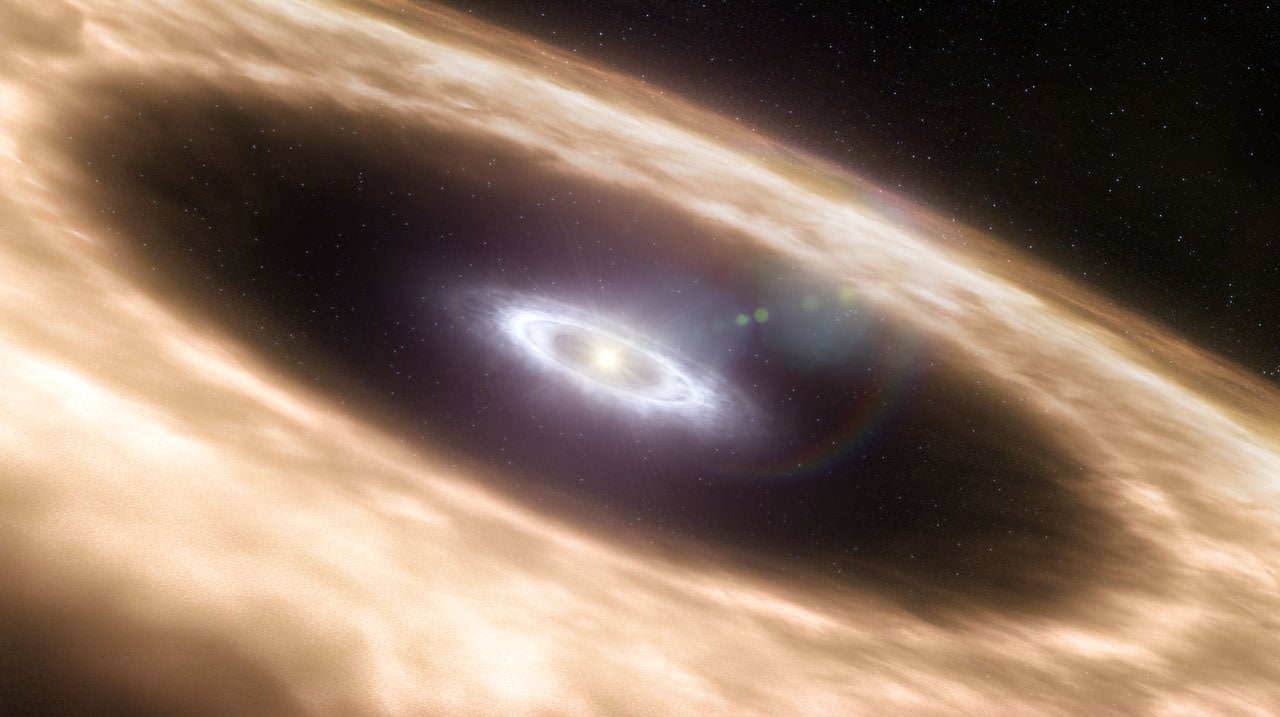
Solar shockwaves would have produced proto-planetary rings at different times, meaning the planets did not form simultaneously (artist concept). Credit: ESO.
Did all the planets in our Solar System form at about the same time? Conventional thinking says the components of our Solar System all formed at the same time, and formed rather quickly. But new research indicates that a series of shockwaves emitted from our very young Sun may have caused the planets to form at different times over millions of years.
"The planets formed in intervals – not altogether, as was previously thought," said Dr. Tagir Abdylmyanov, Associate Professor from Kazan State Power Engineering University in Russia.
Abdylmyanov's research, which models the movements of particles in fluids and gasses and in the gas cloud from which our Sun accreted, indicates that the first series of shockwaves during short but very rapid changes in solar activity would have created the proto-planetary rings for Uranus, Neptune, and dwarf planet Pluto first. Jupiter, Saturn, and the asteroid belt would have come next during a series of less powerful shockwaves. Mercury, Venus, Earth, and Mars would have formed last, when the Sun was far calmer. This means that our own planet is one of the youngest in the Solar System.
"It is difficult to say exactly how much time would have separated these groups," Abdylmyanov said, "but the proto-planetary rings for Uranus, Neptune and Pluto would have likely formed very close to the Sun's birth. 3 million years later and we would see the debris ring destined to form Saturn. Half a million years after this we would see something similar but for Jupiter. The asteroid belt would have begun to form about a million years after that, and another half a million years on we would see the very early stages of Mercury, Venus, Earth and Mars."
The shockwaves emitted from the new-born Sun would have rippled out material at different times, creating a series of debris rings around the Sun from which the planets formed.
Abdylmayanov hopes that this research will help us understand the development of planets around distant stars. "Studying the brightness of stars that are in the process of forming could give indications as to the intensity of stellar shockwaves. In this way we may be able to predict the location of planets around far-flung stars millions of years before they have formed."
His work was part of the European Planetary Science Congress
taking place this week in Madrid, Spain.