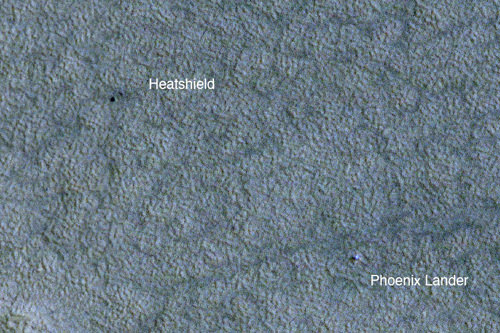
Phoenix Not Covered With Ice -- Yet

[/caption] The HiRISE Camera on board the Mars Reconnaissance Orbiter is keeping an eye on the Phoenix lander, and took the above image of the landing site on Dec. 21, 2008. Phoenix, its heatshield, parachute and backshell are still visible on the Martian arctic plains, providing evidence that the spacecraft hasn't been covered with ice as of yet. Via the HiRISE Blog, scientists say the conditions are hazy and dark because

northern winter

summer is turning to autumn on Mars. They will keep imaging the site as long as there is enough light to see the lander. Compare this image to previous photos of the Phoenix site, below.

[caption id="attachment_23015" align="aligncenter" width="580" caption="Phoenix and accoutrements from May 2008. Credit: NASA/JPL/UA"]

[/caption] This color image was taken just after Phoenix landed in late May 2008. Insets show the backshell, parachute and heatshield.
[caption id="attachment_23028" align="aligncenter" width="500" caption="Phoenix site July 08. Credit: NASA/JPL/UA"]

[/caption] In these images, top one taken in July of 2008, and bottom taken in October 2008, you can compare the lighting conditions between late summer and early fall, and now winter (first image) in the northern arctic regions on Mars. [caption id="attachment_23031" align="aligncenter" width="500" caption="Phoenix September 08. Credit: NASA/JPL/UA"]

[/caption] Source: HiRISE Blog,

HiRISE site

Nancy Atkinson

Nancy Atkinson

Nancy Atkinson is a space journalist and author with a passion for telling the stories of people involved in space exploration and astronomy. She is currently retired from daily writing, but worked at Universe Today for 20 years as a writer and editor. She also contributed articles to The Planetary Society, Ad Astra (National Space Society), New Scientist and many other online outlets.

Her 2019 book, "Eight Years to the Moon: The History of the Apollo Missions,” shares the untold stories of engineers and scientists who worked behind the scenes to make the Apollo program so successful, despite the daunting odds against it. Her first book “Incredible Stories From Space: A Behind-the-Scenes Look at the Missions Changing Our View of the Cosmos” (2016) tells the stories of 37 scientists and engineers that work on several current NASA robotic missions to explore the solar system and beyond.

Nancy is also a NASA/JPL Solar System Ambassador, and through this program, she has the opportunity to share her passion of space and astronomy with children and adults through presentations and programs. Nancy's personal website is nancyatkinson.com