Universe Today
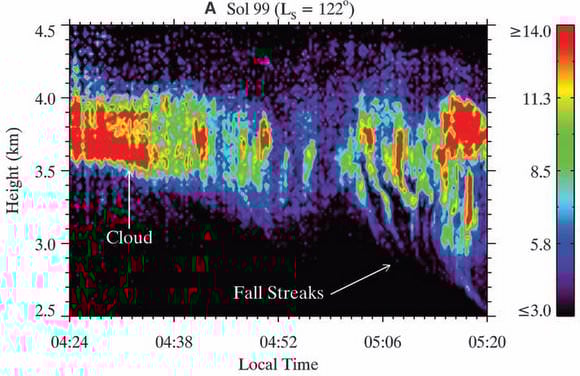
It snows on Mars. This occurs, at least in the northern arctic region where the Phoenix lander set up camp in 2008. Science teams from Phoenix were able to observe water-ice clouds in the Martian atmosphere and precipitation that fell to the ground at night and sublimate into water in the morning. James Whiteway and his colleagues say that clouds and precipitation on Mars play a role in the exchange of water between the ground and the atmosphere and when conditions are right, snow falls regularly on Mars.
“Before Phoenix we did not know whether precipitation occurs on Mars,” Whiteway said. “We knew that the polar ice cap advances as far south as the Phoenix site in winter, but we did not know how the water vapor moved from the atmosphere to ice on the ground. Now we know that it does snow, and that this is part of the hydrological cycle on Mars.”
Phoenix landed at the north arctic region on Mars (68.22°N, 234.25°E) on May 25th, 2008. On Mars, this was just before the summer solstice. Phoenix operated for 5 months, and was able to observe conditions as the seasons changed from summer to winter, giving science teams an unprecedented look at the planet's changing weather patterns, including frost and precipitation.
The science team used the light detection and ranging instrument, known as LIDAR, and observed clouds that are similar to cirrus clouds here on Earth.
The LIDAR instrument emits pulses of laser light upward into the atmosphere, and then detects the backscatter from dust and clouds. The researchers were able to observe that water-ice crystals grow large enough to precipitate through the atmosphere at night and sublimate into water in the morning. The water vapor on the ground is then mixed back up through the air by turbulence and convection – reaching a height of about two and a half miles (four kilometers) – before again forming clouds at night.
Fall streaks in the cloud structure traced the precipitation of ice crystals toward the ground.
"Frost was predicted, but snowfall was quite a welcome surprise," said Phoenix principal investigator Peter Smith. "In summer there was a lot of dust in the atmosphere. As we neared fall, the dust cleared, and all of a sudden there were water ice clouds forming at about 4 km (2.5 mi.) above the surface. We could see the clouds scud by, moving through the camera field, and once we saw snow coming out of the bottom of a cloud. It was very exciting to watch the daily weather changes. No one has ever had this experience."
Using the LIDAR, the team could measurement atmospheric dust in the planetary boundary layer (PBL), the lowest part of the atmosphere which is directly influenced by its contact with a planetary surface.
Whiteway and his team said the PBL on Mars is quite interesting. "The PBL on Mars was well mixed, up to heights of around 4 kilometers, by the summer daytime turbulence and convection," the team wrote in their paper, which is published today in the Journal Science. "The water-ice clouds were detected at the top of the PBL and near the ground each night in late summer after the air temperature started decreasing. The interpretation is that water vapor mixed upward by daytime turbulence and convection forms ice crystal clouds at night that precipitate back toward the surface."
The clouds didn't begin forming until around sol 80 or 90 - the number of days from when Phoenix landed on Mars -- when air temperatures were cool enough for water vapor in the atmosphere to condense. In the early morning hours on sol 109, the LIDAR observed clouds and precipitation that extended all the way to the ground.
The science team said the clouds and precipitation keep the water confined within the PBL. Eventually, the ice clouds would have persisted within the PBL throughout the daytime, and water ice would have remained deposited on the ground. As the depth of the PBL decreased in late summer, the atmospheric water vapor would decrease, and the process would eventually stop as winter progressed.
Source: Science