Universe Today
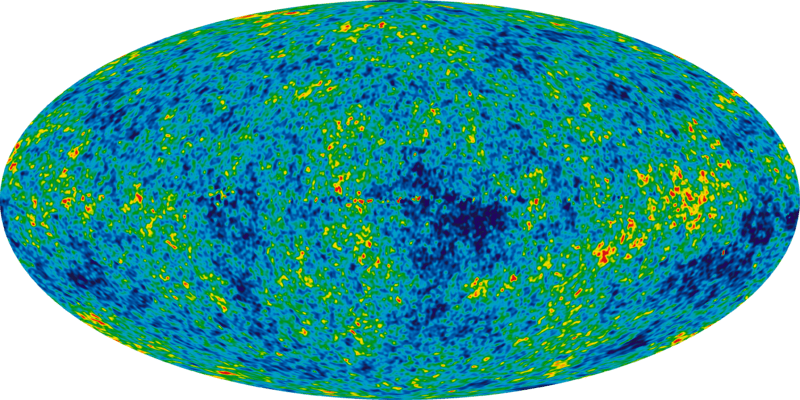
Have scientists seen evidence of time before the Big Bang, and perhaps a verification of the idea of the cyclical universe? One of the great physicists of our time, Roger Penrose from the University of Oxford, has published a new paper saying that the circular patterns seen in the WMAP mission data on the Cosmic Microwave Background suggest that space and time perhaps did not originate at the Big Bang but that our universe continually cycles through a series of "aeons," and we have an eternal, cyclical cosmos. His paper also refutes the idea of inflation, a widely accepted theory of a period of very rapid expansion immediately following the Big Bang.
Penrose says that inflation cannot account for the very low entropy state in which the universe was thought to have been created. He and his co-author do not believe that space and time came into existence at the moment of the Big Bang, but instead, that event was just one in a series of many. Each "Big Bang" marked the start of a new aeon, and our universe is just one of many in a cyclical Universe, starting a new universe in place of the one before.
Penrose’s co-author, Vahe Gurzadyan of the Yerevan Physics Institute in Armenia, analyzed seven years’ worth of microwave data from WMAP, as well as data from the BOOMERanG balloon experiment in Antarctica. Penrose and Gurzadyan say they have identified regions in the microwave sky where there are concentric circles showing the radiation's temperature is markedly smaller than elsewhere.
These circles allow us to "see through" the Big Bang into the aeon that would have existed beforehand. The circles were created when black holes “encountered” or collided with a previous aeon.
“Black-hole encounters, within bound galactic clusters in that previous aeon, would have the observable effect, in our CMB sky,” the duo write in their paper, “of families of concentric circles over which the temperature variance is anomalously low.”
And these circles don’t jive with the idea of inflation, because inflation proposes that the distribution of temperature variations across the sky should be Gaussian, or random, rather than having discernable structures within it.
Penrose's new theory even projects how the distant future might emerge, where things will again be similar to the beginnings of the Universe at the Big Bang where the Universe was smooth, as opposed to the current jagged form. This continuity of shape, he maintains, will allow a transition from the end of the current aeon, when the universe will have expanded to become infinitely large, to the start of the next, when it once again becomes infinitesimally small and explodes outwards from the next big bang.
Penrose and Gurzadyan say that the entropy at the transition stage will be very low, because black holes, which destroy all information that they suck in, evaporate as the universe expands and in so doing remove entropy from the universe.
“These observational predictions of (Conformal cyclic cosmology) CCC would not be easily explained within standard inflationary cosmology,” they write in their paper.
Read Penrose and Gurzadyan's paper: "Concentric circles in WMAP data may provide evidence of violent pre-Big-Bang activity"
Additional source: PhysicsWorld