Universe Today
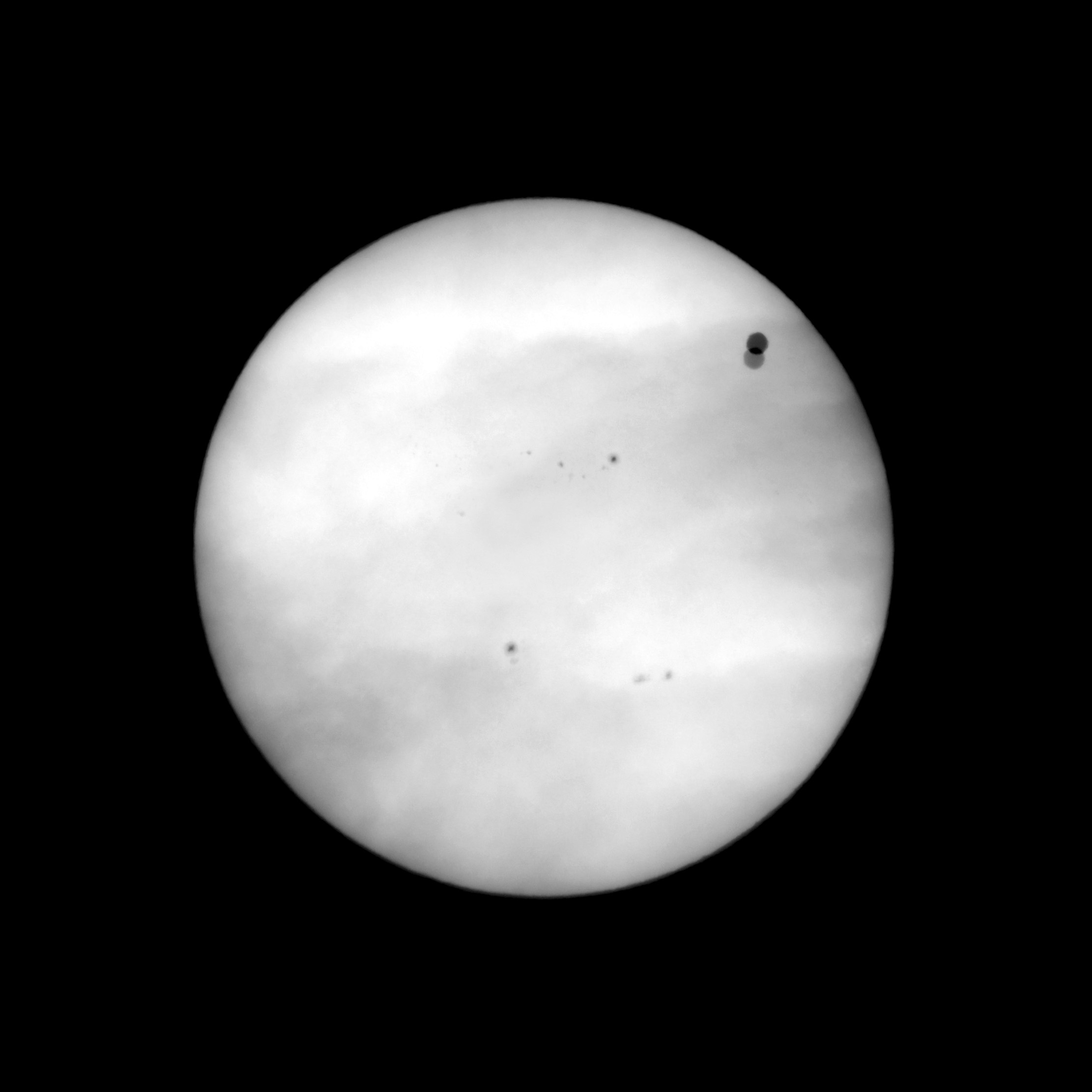
Combined images taken simultaneously (06 June 2012, 03:46:18 UTC) from Svalbard and Canberra, showing the Venus parallax effect from 2 different locations on Earth, separated by 11600km. Credit: Pérez Ayúcar/Breitfellner
Back in the 18th century, astronomers were trying to determine the distance from the Earth to the Sun. They used the parallax method during the Transits of Venus the 1760s to help answer that question, and their results provided a cosmic measuring stick that has allowed astronomers to measure distances in the Universe.
How did that method work? New images and movies of the transit of Venus on June 6, 2012 which compare event from two different locations on Earth clearly show the parallax effects that have made Venus transits so important historically.
The movies compress 6 hours of observations and 5,000 individual images taken by optical and solar telescopes into a 40 second video. Data gaps due to cloudy conditions produce jumps in the otherwise smooth Venus motion across the Sun disk. The observations were taken from Svalbard in Norway and Canberra in Australia, which are separated by 11,600 km (7,200 miles).
When the images from the two locations are compared, the parallax effect is obvious.
By knowing the distance between two observers on Earth and comparing the differences in their observations, astronomers were able to work out the distance from the Earth to Venus. And because of Johannes Kepler's calculations, 18th century astronomers already knew Venus' orbit is about 70 percent that of Earth's. So by knowing the distance between the Earth and Venus, they were also able to figure out the value for the Astronomical Unit.
The images used in the movies were obtained by members of the European Space Astronomy Centre, which is located outside Madrid. Two of the observers, Miguel Pérez Ayúcar and Michel Breitfellner are on the science operations planning team for the Venus Express satellite, which has been orbiting Venus since 2006.
"During the hours of the transit we were delighted by the slow, delicate, gracious passage of Venus in front of the Sun," Ayúcar said. "A perfect black circle, containing a world in it, moving in front of its looming parent star. How thankful we were to witness it. Now with these movies, we can share a sense of that experience."
Breitfellner said, "In the 18th century people realized that transits of Venus could be used to measure the distance from the Earth to the Sun. Teams of astronomers were sent all across the world to measure this effect. The 2012 transit has its own historical importance - it is the first that has occurred when a spacecraft is in orbit at Venus. Science teams are now working to compare observations of the Venus transit from Earth with simultaneous observations from Venus Express."
Colin Wilson, Operations Scientist for Venus Express, said, "Planetary transits are not just of historical interest, they have acquired a new importance in the study of newly discovered planets around other stars. Because we cannot image exoplanets directly, it is only by studying their transits that we can discover whether they harbour liquid water or other potential 'biomarker' molecules like methane or ozone. The Venus transit is an example much closer to home, offering us a chance to test our understanding of how to interpret transit data. This certainly added extra interest as we watched the Venus transit in June - particularly knowing it was our last chance that we'd have to wait until 2117 to see the next one!"
Transit of Venus 2012 from Svalbard and Canberra from Lightcurve Films on Vimeo.
Source:
EPSC