Universe Today
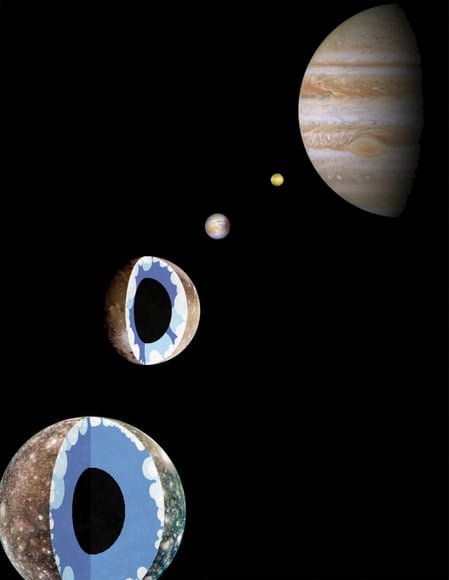
Jupiter's two moons Ganymede and Callisto could be considered fraternal twins. They have a similar composition and size, but visually, they are different. Also, data from the Galileo and Voyager spacecraft reveal the two moons' interiors are very dissimilar, as well. The reasons for the differences have eluded scientists for 30 years, but a new study provides an explanation. During the Late Heavy Bombardment, Callisto escaped relatively unscathed, while Ganymede was a battered child; so much so that the later moon melted. "Impacts during this period melted Ganymede so thoroughly and deeply that the heat could not be quickly removed," said Dr. Amy Barr of the Southwest Research Institute. "All of Ganymede's rock sank to its center the same way that all the chocolate chips sink to the bottom of a melted carton of ice cream. Callisto received fewer impacts at lower velocities and avoided complete melting."
Barr and and Dr. Robin Canup created a model showing how Jupiter's strong gravity focused cometary impactors onto Ganymede and Callisto 3.8 billion years ago, during the LHB period. Each impact onto Ganymede or Callisto's mixed ice and rock surface creates a pool of liquid water, allowing rock in the melt pool to sink to the moon's center.
But Ganymede is closer to Jupiter and therefore was hit by twice as many icy impactors as Callisto. Additionally, the impactors hitting Ganymede had a higher average velocity. Modeling by Barr and Canup shows that core formation begun during the late heavy bombardment becomes energetically self-sustaining in Ganymede but not Callisto.
Watch a movie that shows the effect of an outer solar system late heavy bombardment on the interior structure of Callisto (top model in the movie) and Ganymede (bottom).
"Similar to Earth and Venus, Ganymede and Callisto are twins, and understanding how they were born the same and grew up to be so different is of tremendous interest to planetary scientists," explains Barr. "Our study shows that Ganymede and Callisto record the fingerprints of the early evolution of the solar system, which is very exciting and not at all expected."
The "Ganymede-Callisto dichotomy," has been a classical problem in comparative planetology, a field of study that seeks to explain why some solar system objects with similar bulk characteristics have radically different appearances. The study by Barr and Canup also links the evolution of Jupiter's moons to the orbital migration of the outer planets and the bombardment history of Earth's moon.
Source: SwRI