Universe Today
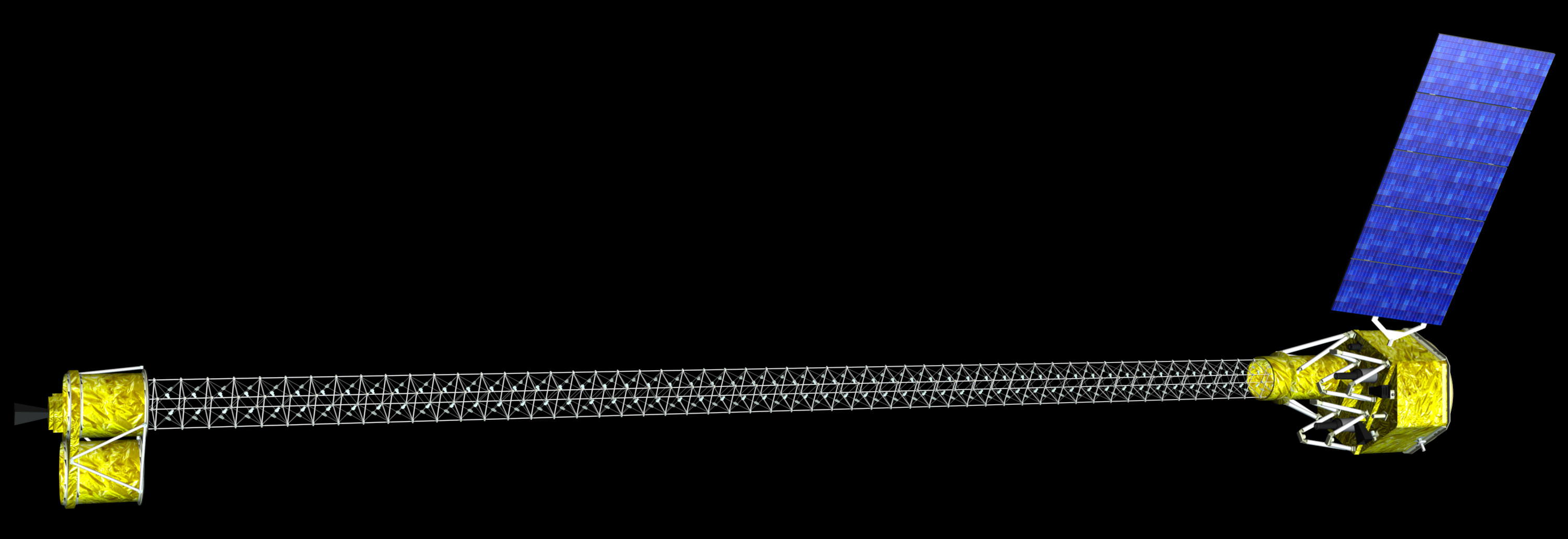
NASA announced today Orbital Sciences Corporation will launch the first high energy X-ray telescope, NuSTAR (Nuclear Spectroscopic Telescope Array) on board a Pegasus XL rocket. Orbital has also been the prime industrial contractor for building NuSTAR itself. The spacecraft will fly in 2011, launching from the Ronald Reagan Ballistic Missile Defense Test Site located at the Pacific Ocean’s Kwajalein Atoll. NuSTAR is the first satellite to fly a focusing X-ray telescope in space for energies in the 8-80 keV range, searching for black holes and supernova remnants.
NuSTAR was canceled in February 2006, but NASA restarted the program in September 2007, after Alan Stern took over as associate administrator for the Science Mission Directorate NASA. "NuSTAR has more than 500 times the sensitivity of previous instruments that detect black holes," Stern said in 2007. "It's a great opportunity for us to explore an important astronomical frontier."
NuSTAR will conduct a census for black holes, map radioactive material in young supernovae remnants, and study the origins of cosmic rays and the extreme physics around collapsed stars.
The Pegasus is one of the most reliable launch system for the deployment of small satellites weighing up to 1,000 pounds into low-Earth orbit. Its patented air-launch system, where the rocket is launched from beneath Orbital's "Stargazer" L-1011 carrier aircraft over the ocean, reduces cost and provides customers with unparalleled flexibility to operate from virtually anywhere on Earth. The Pegasus rocket has been flying since 1990, and has successfully conducted over 54 space launch missions.
The total cost of the NuSTAR launch services is approximately $36 million dollars. This estimated cost includes the task ordered launch service for a Pegasus XL rocket, plus additional services under other contracts for payload processing, launch vehicle integration, and tracking, data and telemetry support.
Source: NASA