Universe Today
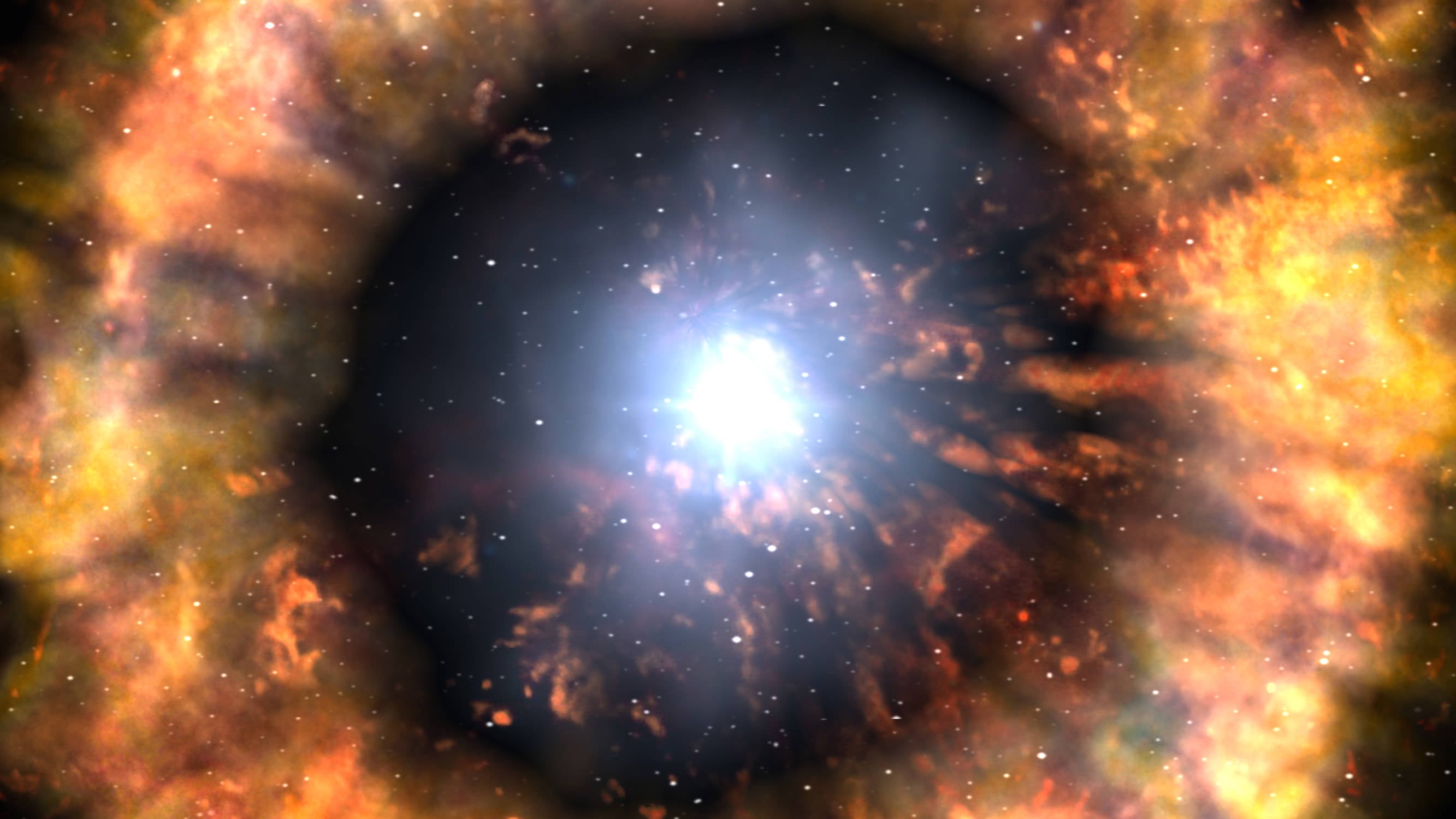
Two of the farthest supernovae ever detected have been found by using a new technique that could help find other dying stars at the edge of the universe. The two cosmic blasts occurred 11 billion years ago. The next-farthest large supernova known occurred about 6 billion years ago. Jeff Cooke from the University of California Irvine said this new method has the potential to allow astronomers to study some of the very first supernovae and will advance the understanding of how galaxies form, how they change over time and how Earth came to be.
A supernova occurs when a massive star (more than eight times the mass of the sun) dies in a powerful, bright explosion. Cooke studies larger stars (50 to 100 times the mass of the sun) that blow part of their mass into their surroundings before they die. When they finally explode, the nearby matter glows brightly for years.
Typically, cosmologists find supernovae by comparing pictures taken at different times of the same swath of sky and looking for changes. Any new light could indicate a supernova.
Cooke built upon this idea. He blended pictures taken over the course of a year, then compared them with image compilations from other years.
"If you stack all of those images into one big pile, then you can reach deeper and see fainter objects," Cooke said. "It's like in photography when you open the shutter for a long time. You'll collect more light with a longer exposure."
This image shows the host galaxy containing one of the newly discovered supernovae. Comparing the images shows how the galaxy visibly brightens in 2004 and then returns to normal. This suggested that in 2003 the supernova was not detected; it appeared in 2004 and was beginning to fade in 2005. The last frame subtracts the images from the years that the supernova was not detected as well as the galaxy’s light to reveal only the supernova. Credit: Jeff Cooke/CFHT
Doing this with images from the Cooke found four objects that appeared to be supernovae. He used a Keck telescope to look more closely at the spectrum of light each object emitted and confirmed they were indeed supernovae.
"The universe is about 13.7 billion years old, so really we are seeing some of the first stars ever formed," Cooke said.
Cooke's paper is published in the journal Nature on July 9.
Source: UC-Irvine