Universe Today
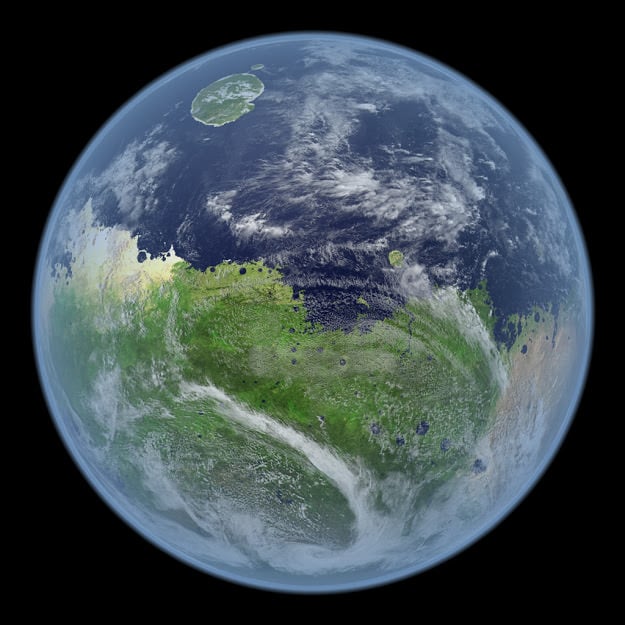
A conception of an ancient and/or future Mars, flush with oceans, clouds and life. Credit:
Over the years, scientists have found evidence revealing that an ocean may have covered parts of the Red Planet billions of years ago. Others suggest that a future terraformed Mars could be lush with oceans and vegetation. In either scenario, what would Mars look like as a planet alive with water and life? By combining data from several sources -- along with a bit of creative license -- software engineer
Kevin Gill
has created some gorgeous images showing concepts of what a "living Mars" might look like from orbit, turning the Red Planet into its own version of the Blue Marble.
"This was something that I did both out of curiosity of what it would look like and to improve the software I was rendering this in," Gill said via email. "I am a software engineer by trade and certainly no planetary scientist, so with the exception of any parts derived from actual data, most of it is assumptions I made based on simply comparing the Mars terrain to similar features here on Earth (e.g. elevation, proximity to bodies of water, physical features, geographical position, etc) and then using the corresponding textures from the Blue Marble images to paint the flat image layer in a graphics program."
For example, the view below is of the western hemisphere of Mars, with Olympus Mons on the horizon beyond the Tharsis Montes volcanoes and the Valles Marineris canyons near the center. Gill said the height of the clouds and atmosphere are largely arbitrary and set for the sake of appearance. The terrain is also exaggerated by about 10 times. The orbital "eye" view is about 10,000 km (~6,200 miles) from the surface.
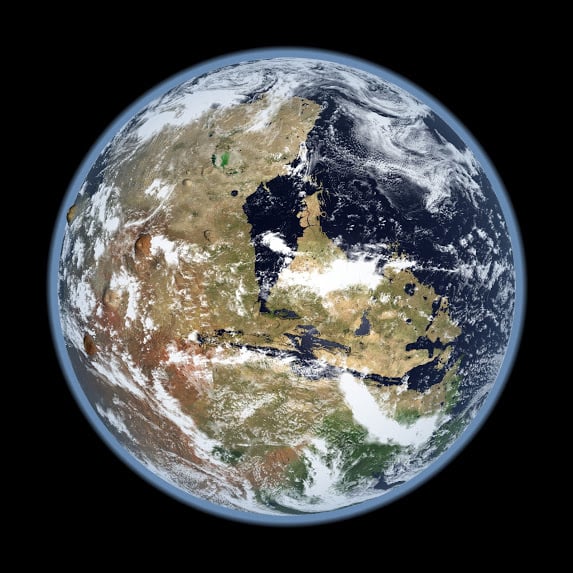
This is a conception view of the Western hemisphere of Mars with oceans and clouds. Olympus Mons is visible on the horizon beyond the Tharsis Montes volcanoes and the Valles Marineris canyons near the center. Credit:
"This wasn't intended as an exhaustive scientific scenario as I'm sure (and expect) some of my assumptions will prove incorrect," Gill said on Google+. "I'm hoping at least to trigger the imagination, so please enjoy!"
He outlined his steps in creating the images:
A two dimensional digital elevation model was first rendered in jDem846 (an open-source learning project of mine) using the MRO MOLA 128 pix/deg elevation dataset. In that model, I picked a sea level and scripted it such that terrain at or below that level was flat and blue.
The resulting model was then brought into GIMP were I painted in land features using a NASA Blue Marble Next Generation image for the source textures. There is no scientific reasoning behind how I painted it; I tried to envision how the land would appear given certain features or the effects of likely atmospheric climate. For example, I didn't see much green taking hold within the area of Olympus Mons and the surrounding volcanoes, both due to the volcanic activity and the proximity to the equator (thus a more tropical climate). For these desert-like areas I mostly used textures taken from the Sahara in Africa and some of Australia. Likewise, as the terrain gets higher or lower in latitude I added darker flora along with tundra and glacial ice. These northern and southern areas textures are largely taken from around northern Russia. Tropical and subtropical greens were based on the rainforests of South America and Africa.
Finally, that image was brought back into jDem846 as a layer to be reapplied to the same MOLA dataset, but rendered as a spherical projection (like Google Earth). I scripted the model to apply a three-dimensional cloud layer, add an atmosphere, and dampen specular lighting on dry land and under clouds. There are some other scripted tweaks here and there.
Gill has also done other visualizations of Mars and also the Moon, which can be seen on his
G+
or
Flickr page
.