Universe Today
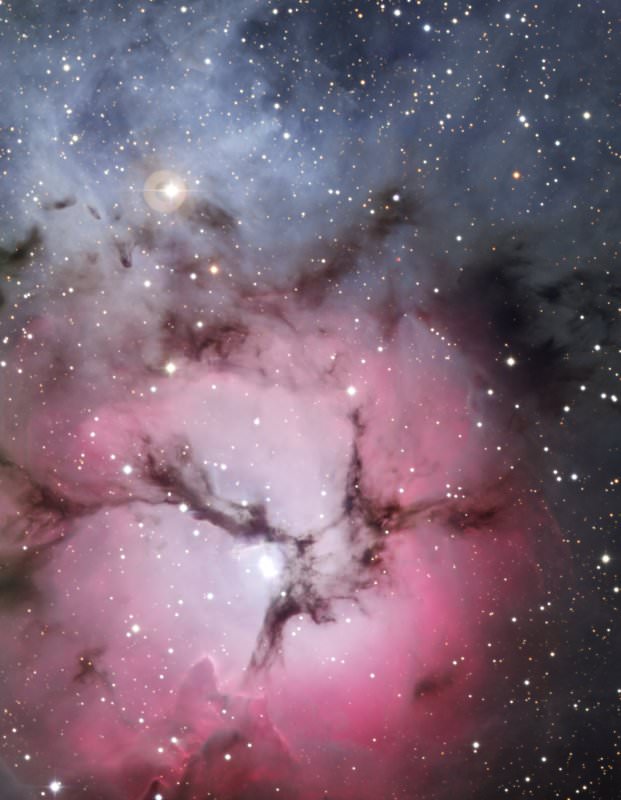
You'll have no trouble at all enjoying these stunning new images of the Trifid Nebula. This massive star factory is so named for the dark dust bands that trisect its glowing heart, and is a rare combination of three nebula types: reflection, emission and dark nebulae. With these new images from ESO’s La Silla Observatory in northern Chile, astronomers are learning more about the early stages of stellar life, from gestation to first light.
Smouldering several thousand light-years away in the constellation of Sagittarius (the Archer), the Trifid Nebula is a favorite target for amateur and professional astronomers alike. These new images shows the heat and “winds” of newly ignited, volatile stars that stir the Trifid’s gas and dust-filled cauldron; in time, the dark tendrils of matter strewn throughout the area will themselves collapse and form new stars.
Made with the Wide-Field Imager camera attached to the MPG/ESO 2.2-metre telescope at ESO’s La Silla Observatory in northern Chile, this new image prominently displays the different regions of the Trifid Nebula as seen in visible light. In the bluish patch to the upper left, called a reflection nebula, gas scatters the light from nearby, Trifid-born stars. The largest of these stars shines most brightly in the hot, blue portion of the visible spectrum. This, along with the fact that dust grains and molecules scatter blue light more efficiently than red light — a property that explains why we have blue skies and red sunsets — imbues this portion of the Trifid Nebula with an azure hue.
In the bottom part of the image, in the round, pink-reddish area typical of an emission nebula, the gas at the Trifid’s core is heated by hundreds of scorching young stars until it emits the red signature light of hydrogen, the major component of the gas, just as hot neon gas glows red-orange in illuminated signs all over the world.
See here for a zoomable image of the Trifid Nebula.
The gases and dust that crisscross the Trifid Nebula make up the third kind of nebula in this cosmic cloud, known as dark nebulae, courtesy of their light-obscuring effects. (The iconic Horsehead Nebula may be the most famous of these). Within these dark lanes, the remnants of previous star birth episodes continue to coalesce under gravity’s inexorable attraction. The rising density, pressure and temperature inside these gaseous blobs will eventually trigger nuclear fusion, and yet more stars will form.
In the lower part of this emission nebula, a finger of gas pokes out from the cloud, pointing directly at the central star powering the Trifid. This is an example of an evaporating gaseous globule, or "EGG", also seen in the Eagle Nebula, another star-forming region. At the tip of the finger, which was photographed by Hubble, a knot of dense gas has resisted the onslaught of radiation from the massive star.
Source: ESO