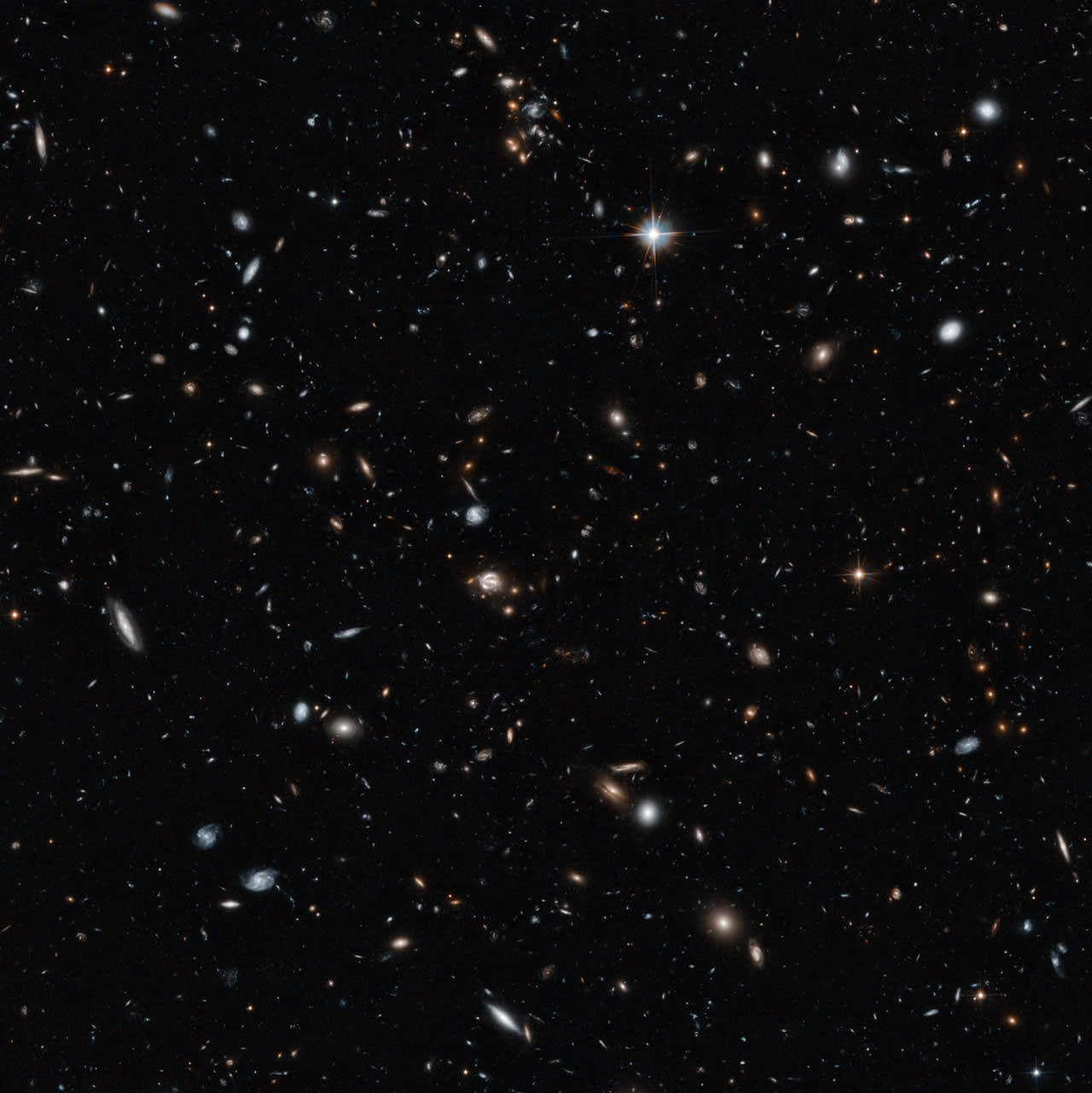
New Hubble View Shows Objects a Billion Times Fainter Than Your Eyes Can See

While this image isn't as deep as the Hubble Deep Field, this 14-hour exposure by the Hubble Space Telescope shows objects around a billion times fainter than what can be seen with the human eyes alone. Astronomers say this image also offers a remarkable depth of field that lets us see more than halfway to the edge of the observable Universe.

As well, this image also provides an extraordinary cross-section of the Universe in both distance and age, showing objects at different distances and stages in cosmic history, and ranges from some of our nearest neighbors to objects seen in the early years of the Universe.

[caption id="attachment_111322" align="aligncenter" width="580"]

Annotated image of the field around CLASS B1608+656. Credit: NASA/ESA.[/caption] Most of the galaxies visible here are members of a huge cluster called CLASS B1608+656, which lies about five billion light-years away. But the field also contains other objects, both significantly closer and far more distant, including quasar QSO-160913+653228 which is so distant its light has taken nine billion years to reach us, two thirds of the time that has elapsed since the Big Bang.

Since the Hubble Deep Field combined 10 days of exposure and the eXtreme Deep Field, or XDF was assembled by combining ten years of observations (with over 2 million seconds of exposure time), this image at 14 hours of exposure may seem "small." But it shows the power of the Hubble Space Telescope.

Also of note is that this image was "found" in the

Hubble Hidden Treasures

vault -- where members of the public are able to search Hubble's science for the best overlooked images that have never been seen by a general audience. This image of CLASS B1608+656 has been well-studied by scientists over the years, but this is the first time it has been published in full online.

Take a zooming view through the image in the video below and read more about this image

here.

Loading player...

var sdfile = 'http://www.spacetelescope.org/static/archives/videos/medium_flash/heic1408a.flv';var imagefile = 'http://www.spacetelescope.org/static/archives/videos/videoframe/heic1408a.jpg';var flashsrc = 'http://www.spacetelescope.org/static/djangoplicity/shadowbox3/libraries/mediaplayer5/player.swf';var sharelink = 'http://www.spacetelescope.org/videos/heic1408a/';var sharecode = '';var gaid = 'UA-2368492-6';var ipadfile = 'http://www.spacetelescope.org/static/archives/videos/medium_podcast/heic1408a.m4v';var mobilefile = 'http://www.spacetelescope.org/static/archives/videos/medium_podcast/heic1408a.m4v';var hdfile = 'http://www.spacetelescope.org/static/archives/videos/hd_and_apple/heic1408a.m4v';;

Source:

Hubble ESA

Nancy Atkinson

Nancy Atkinson

Nancy Atkinson is a space journalist and author with a passion for telling the stories of people involved in space exploration and astronomy. She is currently retired from daily writing, but worked at Universe Today for 20 years as a writer and editor. She also contributed articles to The Planetary Society, Ad Astra (National Space Society), New Scientist and many other online outlets.

Her 2019 book, "Eight Years to the Moon: The History of the Apollo Missions,” shares the untold stories of engineers and scientists who worked behind the scenes to make the Apollo program so successful, despite the daunting odds against it. Her first book “Incredible Stories From Space: A Behind-the-Scenes Look at the Missions Changing Our View of the Cosmos” (2016) tells the stories of 37 scientists and engineers that work on several current NASA robotic missions to explore the solar system and beyond.

Nancy is also a NASA/JPL Solar System Ambassador, and through this program, she has the opportunity to share her passion of space and astronomy with children and adults through presentations and programs. Nancy's personal website is nancyatkinson.com