Universe Today
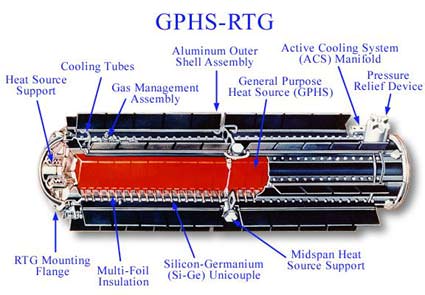
As if things weren't tight enough at NASA, now the US House and Senate have decided to cut the funding to restart production of plutonium-238 (Pu-238), the power source for many of NASA's robotic spacecraft. Under the Atomic Energy Act of 1954, only the US Department of Energy is allowed to possess, use and produce nuclear materials and facilities, and so NASA must rely on the DOE to produce these power sources and the fuel. A report by the National Research Council says "the day of reckoning has arrived" and that NASA has already been forced to limit deep space missions due to the short supply of Pu-238.
Pu-238 is needed for radioisotope thermoelectric generators (RTGs) that supply power for systems and instruments on spacecraft travel too far from the Sun to rely on solar energy or land on surfaces with long "nights." For example, the Voyager spacecraft utilize RTGs and are still able to communicate and return science data after over 30 years of operation, and now are at the outer edges of our solar system.
Pu-238 is expensive to produce, but it gives off low-penetration alpha radiation, which is much easier to shield against than the radiation produced by other isotopes.
Pu-238 does not occur in naturally, and the United States has not produced any since the late 1980s. It purchased Pu-238 for NASA missions from Russia during the 1990s, but those supplies reportedly are now exhausted. The NRC based its estimate of NASA's Pu-238 requirements on a letter NASA sent to DOE on April 29, 2008 detailing space science and lunar exploration missions planned for the next 20 years.
The cost of restarting production appears to be the major reason for the cut, as estimates are it would cost at least $150 million.
The DOE requested $30 million in FY2010 to restart production, but the House cut that to $10 million when it passed the FY2010 Energy and Water appropriations bill (H.R. 3183) on July 17. The Senate went even further (S. 1436), completely cutting funds for restarting production of Pu-238.
Both the House and Senate Appropriations Committees complained that DOE had not explained how it would use the funds.
But if funds aren't made available soon, NASA may have to revamp its plans significantly for the New Frontiers missions, lunar rovers, and other deep space missions. There are other isotopes that have been used in the past, such as strontium-90, but Pu-238 has been found to work the best. NASA has also solicited ideas for alternative power sources, as well.
Source: Space Policy Online