Universe Today
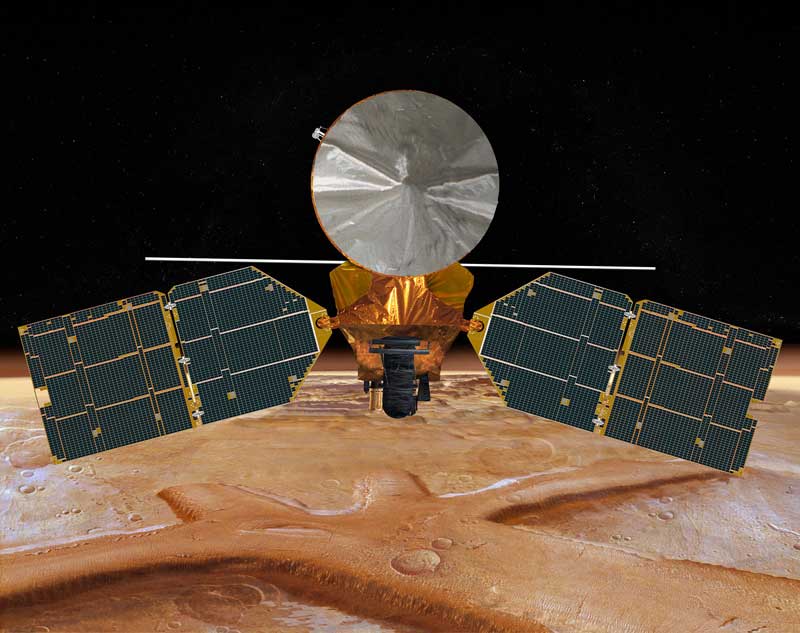
The latest word on the Mars Reconnaissance Orbiter is that the spacecraft has successfully come out of safe mode. The various instruments, including the HiRISE camera are still "safed" at this point, and engineers are waiting for acquisition of signal to confirm mapping orientation. MRO spontaneously rebooted its computer on Aug. 26, and since this was the fourth time this type of event had occurred, flight engineers decided to keep the spacecraft in safe mode, and have been working to figure out possible root causes, as well as repercussions if these events were to continue to happen. Several protective files were uploaded to MRO in late November, with hopes of returning the orbiter to its regularly scheduled research and relay activities. Once engineers check out of all the science instruments, normal science operations may resume next week.
"The patient is out of danger but more steps have to be taken to get it back on its feet," said Mars Reconnaissance Orbiter Project Manager Jim Erickson.
Since August, the team worked painstakingly on a plan to ensure the safety and operation of the orbiter. "This process is to bulletproof the spacecraft against a remote vulnerability that our team identified," said Erickson. "Meanwhile, analysis of possible root causes for the four reboots this year continues as another important part of our path toward resuming science operations."
The preventive care required amending some data files in the computers' non-volatile, or "flash" memories where the computers check for default settings when they reboot.
The four reboots involved a device, called the "computer module interface controller," that controls which of two redundant main computers on the spacecraft is active. Still undetermined is whether trouble lies with that controller itself or with a voltage glitch elsewhere on the spacecraft. The Aug. 6 reboot, though not the other three, prompted a switch from one computer to its backup twin. More than 100 factors are under consideration as possible root causes.
MRO has six instruments on board to examine Mars in detail, from subsurface layers to the top of the atmosphere.
"The precautionary steps we are taking are not driven by the calendar, but by our commitment to care for this valuable national resource," Erickson said. "We are all eager to have science observations resume as soon as a properly cautious process allows."