Universe Today
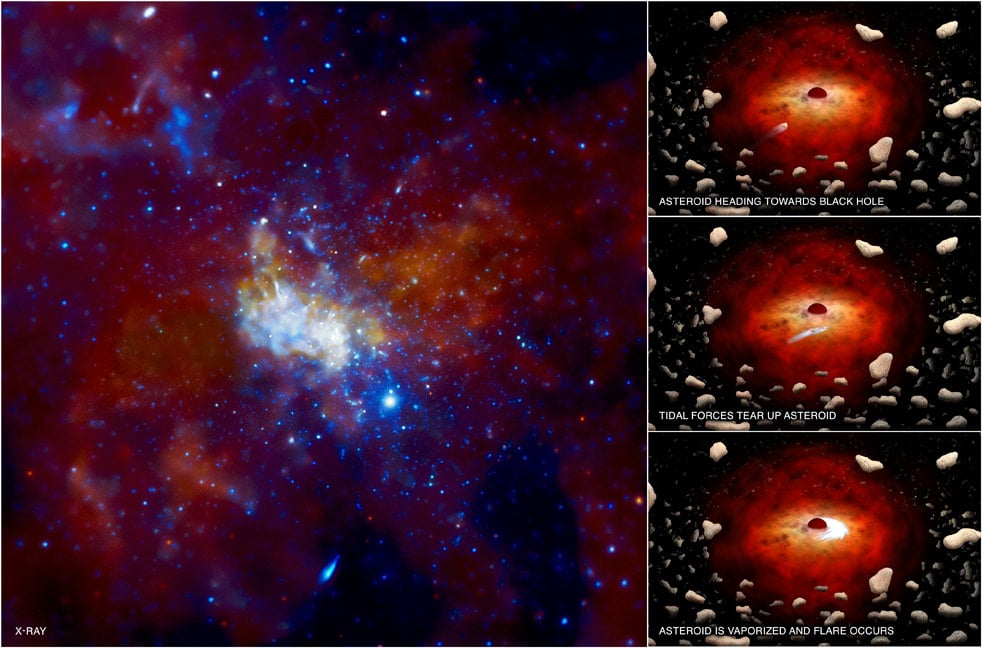
For the past several years, the Chandra telescope has detected X-ray flares occurring about once a day from the supermassive black hole at the center of the Milky Way Galaxy. These flares last a few hours with brightness ranging from a few times to nearly one hundred times that of the black hole's regular output. What could be causing these unusual, mysterious flares? Scientists have determined that the black hole could be feasting hungrily on asteroids that come too close and vaporizing them, creating the flares. Basically, the black hole is eating asteroids and then belching out X-ray gas.
If confirmed, this result would mean that there is a huge, bustling cloud around the black hole containing hundreds of trillions of asteroids and comets.
"People have had doubts about whether asteroids could form at all in the harsh environment near a supermassive black hole," said Kastytis Zubovas of the University of Leicester in the United Kingdom, and lead author of a new paper. "It's exciting because our study suggests that a huge number of them are needed to produce these flares."
The scientists say this really isn’t as far-fetched as it may sound, as it mirrors an event that regularly takes place in our Solar System: About every three days a comet is destroyed when it flies into the hot atmosphere of the Sun. Despite the significant differences in the two environments, the destruction rate of comets and asteroids by the Sun and the black hole at the center of our galaxy, called Sagittarius A*, or "Sgr A*" for short, may be similar.
These asteroids and comets have likely been ripped from their parent stars, and to create the flare the asteroids or comets have to be fairly large, at least 19 km (12 miles) wide.
The astronomers propose this scenario: An asteroid undergoes a close encounter with another object, such as a star or planet, and is thrown into an orbit headed towards Sgr A*. If the asteroid passes within about 100 million miles of the black hole, roughly the distance between the Earth and the Sun, it would be torn into pieces by the tidal forces from the black hole. These fragments then would be vaporized by friction as they pass through the hot, thin gas flowing onto Sgr A*, similar to a meteor heating up and glowing as it falls through Earth's atmosphere. A flare is produced and the remains of the asteroid are swallowed eventually by the black hole.
"An asteroid's orbit can change if it ventures too close to a star or planet near Sgr A*," said co-author Sergei Nayakshin, also of the University of Leicester. "If it's thrown toward the black hole, it's doomed."
The team says these results reasonably agree with models estimating of how many asteroids are likely to be in this region, assuming that the number around stars near Earth is similar to the number surrounding stars near the center of the Milky Way.
"As a reality check, we worked out that a few trillion asteroids should have been removed by the black hole over the 10-billion-year lifetime of the galaxy," said co-author Sera Markoff of the University of Amsterdam in the Netherlands. "Only a small fraction of the total would have been consumed, so the supply of asteroids would hardly be depleted."
This scenario would not be limited to asteroids and comets, however. Planets thrown into orbits too close to Sgr A* also could also be disrupted by tidal forces, although planets in the region are less common. And of course, if a planet was consumed, it would create an even larger flare; and this may have occurred about a century ago when Sgr A* brightened by about a factor of a million. Chandra and other X-ray missions have seen evidence of an X-ray "light echo" reflecting off nearby clouds, providing a measure of the brightness and timing of the flare.
"This would be a sudden end to the planet's life, a much more dramatic fate than the planets in our solar system ever will experience," Zubovas said.
Very long observations of Sgr A* will be made with Chandra later in 2012 that will give valuable new information about the frequency and brightness of flares and should help to test the model proposed here to explain them. The team said this work could improve understanding about the formation of asteroids and planets in the harsh environment of Sgr A*.
Paper: "Sgr A* flares: tidal disruption of asteroids and planets?"; K. Zubovas, S. Nayakshin, S. Markoff"