Universe Today
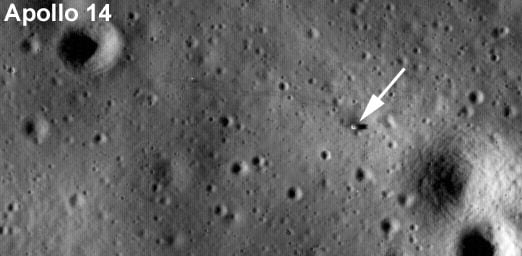
As anticipated, NASA released images of the Apollo landing sites taken by the Lunar Reconnaissance Orbiter (LRO). The pictures show the Apollo missions' lunar module descent stages sitting on the moon's surface, as long shadows from a low sun angle make the modules' locations evident. Also visible are the tracks left where the astronauts walked repeatedly in a "high traffic zone" and perhaps by the Modularized Equipment Transporter (MET) wheelbarrow-like carrier used on Apollo 14. Wow.
As a journalist, I (most of the time) try to remain objective and calm. But there's only one response to these images: W00T!
These first images were taken between July 11 and 15, and the spacecraft is not yet in its final mapping orbit. Future LROC images from these sites will have two to three times greater resolution.
These images are the first glimpses from LRO," said Michael Wargo, chief lunar scientist, NASA Headquarters, Washington. "Things are only going to get better."
The Japanese Kaguya spacecraft previously took images of some of the Apollo landing sites, but not at a high enough resolution to show any of the details of the lander or any other details. But here on these images, the hardware is visible. "It's great to see the hardware on the surface, waiting for us to return," said Mark Robinson, principal investigator for LRO.
Robinson said the LROC team anxiously awaited each image. "We were very interested in getting our first peek at the lunar module descent stages just for the thrill -- and to see how well the cameras had come into focus. Indeed, the images are fantastic and so is the focus."
The Lunar Reconnaissance Orbiter Camera, or LROC, was able to image five of the six Apollo sites, with the remaining Apollo 12 site expected to be photographed in the coming weeks.
The spacecraft's current elliptical orbit resulted in image resolutions that were slightly different for each site but were all around four feet per pixel. Because the deck of the descent stage is about 12 feet in diameter, the Apollo relics themselves fill an area of about nine pixels. However, because the sun was low to the horizon when the images were made, even subtle variations in topography create long shadows. Standing slightly more than ten feet above the surface, each Apollo descent stage creates a distinct shadow that fills roughly 20 pixels.
The image of the Apollo 14 landing site had a particularly desirable lighting condition that allowed visibility of additional details. The Apollo Lunar Surface Experiment Package, a set of scientific instruments placed by the astronauts at the landing site, is discernable, as are the faint trails between the module and instrument package left by the astronauts' footprints.
Source: NASA