Universe Today
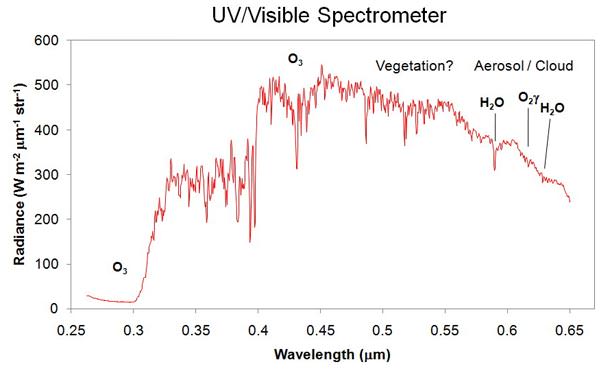
The LCROSS spacecraft took a look back at Earth, and guess what it saw? Evidence of intelligence? Not so much. But it did see evidence of life. On Aug. 1, 2009, the LCROSS spacecraft took a gander at Earth to help calibrate and test its science payload. During the Earth observations, the spacecraft's spectrometers were able to detect the signatures of the Earth's water, ozone, methane, oxygen, carbon dioxide and possibly vegetation.
Phil Plait explained on Bad Astronomy that this spectrum covers part of the ultraviolet and visible range of light, and this type of observation with better instruments in the future could help us find life on other planets. Phil wrote. "You can see that LCROSS clearly detected ozone (O3) and water, which you might see on any old planet. But it also saw a feature that is from free oxygen (O2), something you don’t see just anywhere .… The only reason we have a lot of it in our air (more than 20% of the Earth’s atmosphere is O2) is because we have life in the form of plants." Check out Phil's post here.
The spacecraft also took these images of Earth, again, helping to refine camera exposure settings, check instrument pointing alignment, and check radiometric and wavelength calibrations.
LCROSS is in an elongated Earth orbit, and on course to impact the Moon's south pole in October. From its current vantage point of 223,700 miles (360,000 km) from Earth, the LCROSS science team changed exposure and integration settings on the spacecraft's infrared cameras and spectrometers and performed a crossing pattern, pushing the smaller fields of view of the spectrometers across the Earth’s disk. At this range, the Earth was approximately 2.2 degrees in diameter.
"The Earth-look was very successful," said Tony Colaprete, LCROSS project scientist. "The instruments are all healthy and the science teams was able to collect additional data that will help refine our calibrations of the instruments."
An additional Earth-look and a moon-look are scheduled for the remainder of the cruise phase of the mission.
Sources: NASA, Bad Astronomy