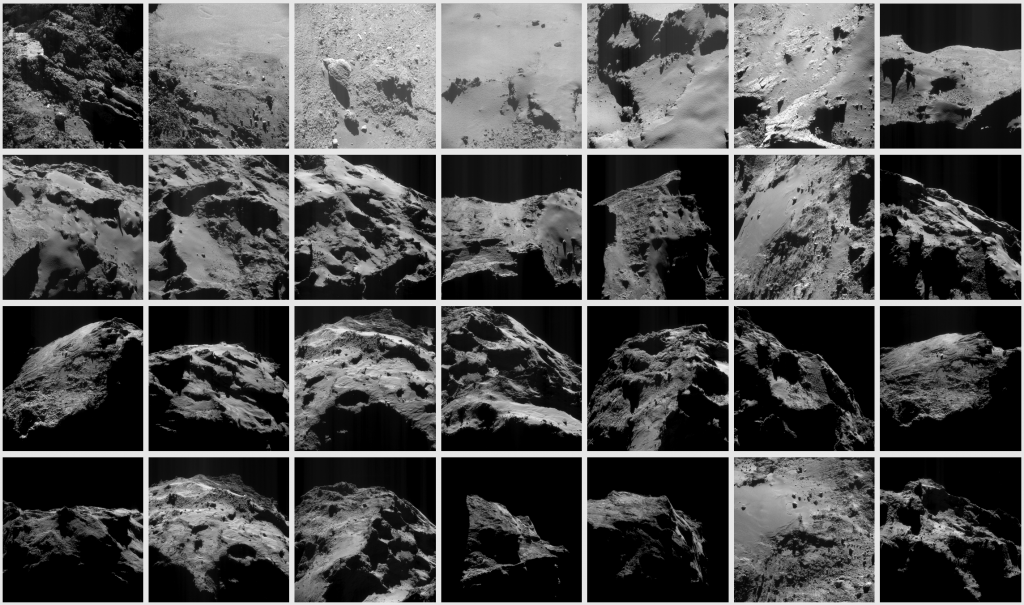
Here Are the Last Images We'll Ever See From Rosetta

The Rosetta team has released the final batch of images taken by the NAVCAM during the last month of its two years of investigations at Comet 67P/Churyumov-Gerasimenko. It's a big batch and they are absolutely stunning, but its sad to know they are the last NAVCAM images. The image set covers the period from September 2-30, 2016 when the spacecraft was on elliptical orbits that sometimes brought it to within 2 km of the comet's surface, so you'll see a wide variety of imagery with a variety of geology and lighting conditions.

Take a look below:

[caption id="attachment_131574" align="aligncenter" width="580"]

A large boulder sits precariously on Comet 67P/Churyumov-Gerasimenko as seem by Rosetta's NAVCAM on September 11, 2016. Credit: ESA/Rosetta/NAVCAM – CC BY-SA IGO 3.0.[/caption]

While these are the final NAVCAM images, there may be more images coming from the OSIRIS camera. Also, many other instruments will be releasing data, as they were active as long as possible before impact. Many of the science instruments were expected to return their last data from between 20 meters to 5 meters above the surface.

ROSINA (Rosetta Orbiter Spectrometer for Ion and Neutral Analysis) collected data on the density of gas around the comet and its composition while GIADA (Grain Impact Analyser and Dust Accumulator) measured the dust density.

RPC's (Rosetta Plasma Consortium) instrument suite provided a look at interaction between the solar wind and the surface of the comet. Alice, an Ultraviolet Imaging Spectrometer similar to the one on New Horizons, took high resolution ultraviolet spectra of the surface. RSI (Radio Science Investigation) got the most accurate measurements of the gravity field during descent.

[caption id="attachment_131573" align="aligncenter" width="580"]

A variety of geology and light on on Comet 67P/Churyumov-Gerasimenko as seem by Rosetta's NAVCAM on September 5, 2016. Credit: ESA/Rosetta/NAVCAM – CC BY-SA IGO 3.0.[/caption]

[caption id="attachment_131572" align="aligncenter" width="580"]

A field of bright bolders on Comet 67P/Churyumov-Gerasimenko as seem by Rosetta's NAVCAM during September 2-20. Credit: ESA/Rosetta/NAVCAM – CC BY-SA IGO 3.0.[/caption]

And here's one of the last five images from Rosetta's NAVCAM as it descended to its

controlled impact on September 30

onto Comet 67P, taking incredible, close-up images during descent, this one just 18.1 km up. It shows the "drippy icing" landscape on this portion of the comet:


[caption id="attachment_131575" align="aligncenter" width="580"]

Single frame enhanced NavCam image taken on September 30, 2016 at 00:27 GMT, when Rosetta was 18.1 km from the center of the nucleus of Comet 67P/Churyumov-Gerasimenko. The scale at the surface is about 1.5 m/pixel and the image measures about 1.6 km across. ESA/Rosetta/NAVCAM – CC BY-SA IGO 3.0.[/caption]

You can see all the final images at the Rosetta blog.

Nancy Atkinson

Nancy Atkinson

Nancy Atkinson is a space journalist and author with a passion for telling the stories of people involved in space exploration and astronomy. She is currently retired from daily writing, but worked at Universe Today for 20 years as a writer and editor. She also contributed articles to The Planetary Society, Ad Astra (National Space Society), New Scientist and many other online outlets.

Her 2019 book, "Eight Years to the Moon: The History of the Apollo Missions,” shares the untold stories of engineers and scientists who worked behind the scenes to make the Apollo program so successful, despite the daunting odds against it. Her first book “Incredible Stories From Space: A Behind-the-Scenes Look at the Missions Changing Our View of the Cosmos” (2016) tells the stories of 37 scientists and engineers that work on several current NASA robotic missions to explore the solar system and beyond.

Nancy is also a NASA/JPL Solar System Ambassador, and through this program, she has the opportunity to share her passion of space and astronomy with children and adults through presentations and programs. Nancy's personal website is nancyatkinson.com