Universe Today
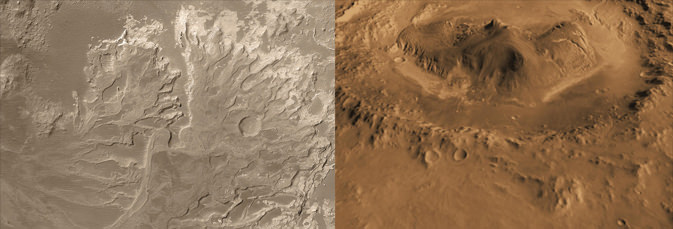
Although a rumor came out about a week and a half ago that Gale Crater was the scientists’ preferred landing site for the Mars Science Laboratory, officially NASA says the finalists are now down to two: Gale and Eberswalde craters. The final selection will likely be made sometime this month, no earlier than July 11. As of now, MSL, a.k.a Curiosity scheduled to head to Mars during a Nov. 25 to Dec. 18, 2011 launch window.
Gale Crater contains ancient lakebed deposits and sitting in the middle of the crater is an enticing 5-kilometer-tall mound of rock, stacked with layers. This could provide the rover a study a variety of environments that produced clay deposits near the mountain's base to later environments that produced sulfate deposits partway up the slope.
Eberswalde is the site of what scientists think is a former river delta, where organic materials could be waiting to be analyzed. NASA says that as a clay-bearing site where a river once flowed into a lake, Eberswalde crater offers a chance to use knowledge that oil industry geologists have accumulated about where in a delta to look for any concentrations of carbon chemistry, a crucial ingredient for life. Officially out of the running are Mawrth Vallis and Holden Crater, the other two finalist sites.
The spacecraft will arrive at Mars in August 2012, and land via its unusual “sky crane” landing system. (See a video of it here.) Researchers will use the rover's 10 science instruments for at least two years to investigate whether the landing area has ever offered environmental conditions favorable for microbial life.
Source: NASA