Universe Today
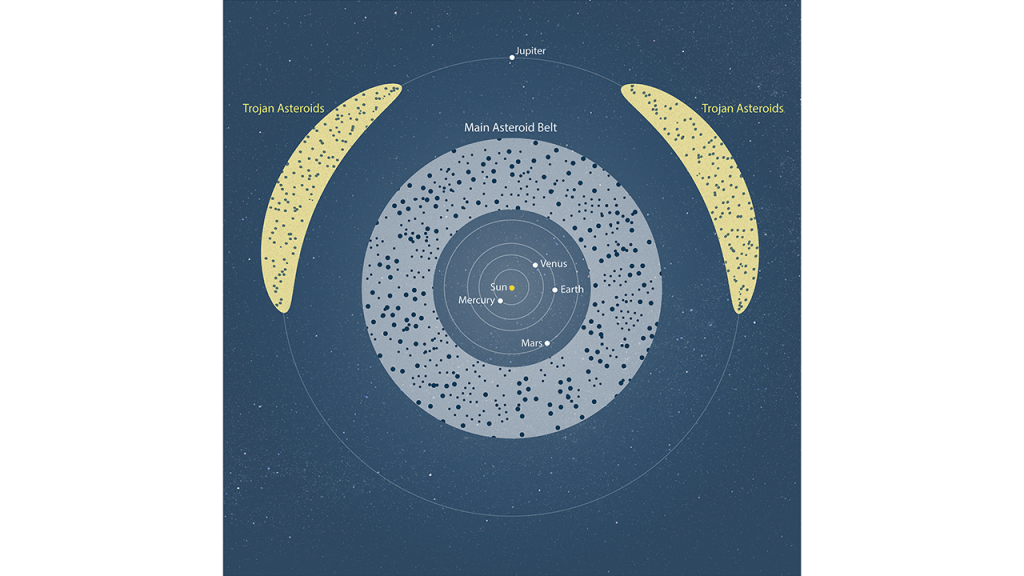
Jupiter is notorious for capturing objects that venture too close to the gas giant and its enormous pull of gravity. Asteroids known as Jupiter Trojans are a large group of space rocks that have been snared by the planet, which usually remain in a stable orbit near one of the Jupiter's Lagrangian points.
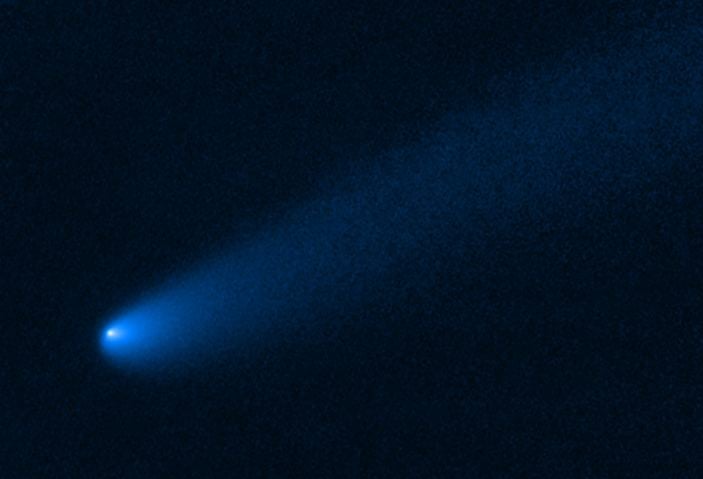
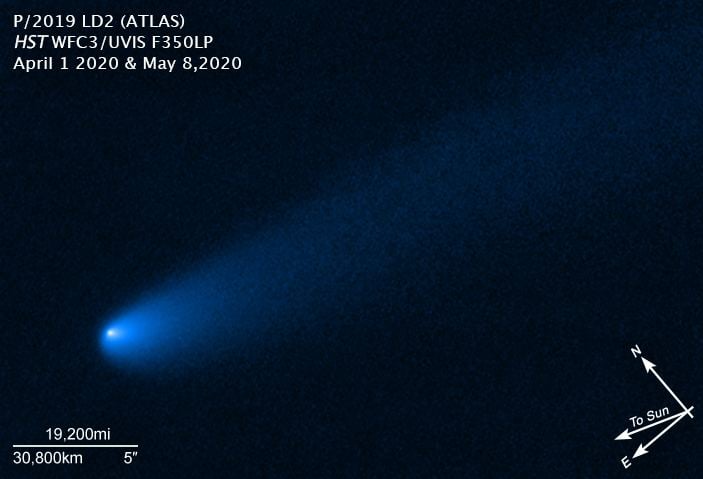
But now, the Hubble Space Telescope has spotted a comet near Jupiter's Trojan asteroid population. This is the first time a comet has been found in this region, and the team of scientists studying the object – named P/2019 LD2 (LD2) – think the unexpected comet is only a temporary visitor.
Researchers think the monster planet's gravitational tug will eventually kick the comet back to its original orbit towards the Sun.
"The visitor had to have come into the orbit of Jupiter at just the right trajectory to have this kind of configuration that gives it the appearance of sharing its orbit with the planet," said lead Hubble researcher Bryce Bolin from Caltech. "We're investigating how it was captured by Jupiter and landed among the Trojans. But we think it could be related to the fact that it had a somewhat close encounter with Jupiter."
P/2019 LD2 (LD2) belongs to a class of icy bodies that are usually found in space between Jupiter and Neptune, called Centaurs. Centaurs become active as they approach the Sun and warm up. Then they dynamically transition into becoming more comet-like.
The team's observations with Hubble shows the object is showing signs of becoming an active comet, sprouting a long tail, outgassing jets of material, and enshrouding itself in a coma of dust and gas.
"Only Hubble could detect active comet-like features this far away at such high detail, and the images clearly show these features, such as a roughly 400,000-mile-long broad tail and high-resolution features near the nucleus due to a coma and jets," said Bolin.
The object was first seen in early June 2019 by the University of Hawaii's Asteroid Terrestrial-impact Last Alert System (ATLAS) telescopes. Several other telescopes, including the Spitzer Space Telescope (just before it was retired), performed follow-up observations, providing clues to the composition of the comet-like object and the gasses driving its activity. Visible light images by Hubble provided more details.
The research team performed computer simulations of P/2019 LD2 (LD2)'s projected path, which showed the object probably swung close to Jupiter about two years ago. The planet then gravitationally booted the wayward visitor to the Trojan asteroid group's co-orbital location, leading Jupiter by about 437 million miles.
"The cool thing is that you're actually catching Jupiter flinging this object around and changing its orbital behavior and bringing it into the inner system," said team member Carey Lisse of the Johns Hopkins University Applied Physics Laboratory (APL). "Jupiter controls what's going on with comets once they get into the inner system by altering their orbits."
Currently, no spacecraft has ever visited the Trojan asteroids. But later this year, a mission called Lucy will fly by seven Trojan asteroids, plus a main belt asteroid, to survey the diversity of this population in a single 12-year record-breaking mission. The Lucy spacecraft launch window opens Oct. 16, 2021.
Further reading:
Paper published in The Astronomical Journal
Hubble Space Telescope Press Release
Article: Jupiter’s Trojan Asteroids Offer Surprises Even Before NASA’s Lucy Mission has a Chance to Visit Them.