Universe Today
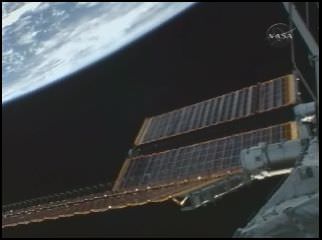
The International Space Station should now be the second brightest object in the night sky, following Friday's successful deploy of the S6 solar wings. Astronauts on board the ISS and space shuttle Discovery unfurled the arrays, successfully carrying out the main objective of the STS-119 mission. "Today was a great day," said ISS commander Mike Fincke to mission control Friday afternoon. "Today is the day the station went to full power." The length of the arrays unfurled Friday measures 73 meters (240 feet), tip to tip, with the S6 truss in between. The S6 solar array pair adds 2,926 892 square meters (9,600 square feet) to the station solar arrays, bringing the total surface area to nearly an acre. The station’s arrays now will generate as much as 120 kilowatts of usable electricity, enough to power about 42 854 260 square meter (2800-square-foot) homes.
The station should now be the second brightest object in the night sky --even brighter than Venus, and second only to the Moon.
The deployment proceeded without any problems, as the astronauts unfurled the arrays in a gradual process, deploying the arrays half way, then letting the sun warm the arrays to decrease the probability of the "stiction" problem, where the solar array blanket slats stick together due to a protective sticky film on the slats. The solar arrays have been in storage for several years, all folded up. The areas of "ripple" flattened out naturally and the crew and Mission Control reported the array extended to its full length of 35 meters (115 feet) on each side. The new arrays add enough power-generating capacity to double the electricity available for space station science operations, from 15 to 30 kilowatts.
This is great time to take the opportunity to view the station as it passes over North America and Europe. For more information on how to see the ISS, see our previous article on viewing the station.