Universe Today
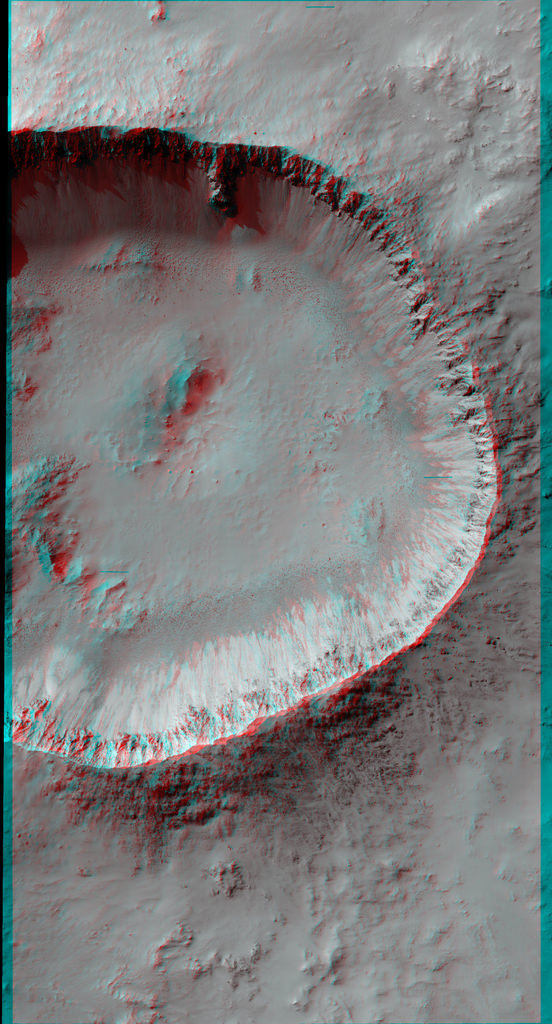
This is why I always keep a pair of 3-D glasses by my computer. This well-preserved crater on Mars may look like just your average, run-of-the-mill impact crater in 2-D, but in 3-D, the sharply raised rim, the deep, cavernous crater body, and especially the steep crater walls will have you grabbing your armchairs so you don’t fall in. The image is courtesy of the HiRISE camera team from the Mars Reconnaissance Orbiter. This unnamed crater is about 6 or 7 kilometers wide from rim to rim. HiRISE took the image on New Year’s Eve 2011.
HiRISE principal investigator Alfred McEwen says that the camera has imaged hundreds of well-preserved impact craters on Mars ranging from 1 meter to more than 100 kilometers wide. What can the scientists learn from craters?
“These targets are of great interest for multiple reasons,” he said. “First, we want to better understand impact cratering, a fundamental surface process. Second, such craters often contain good exposures of bedrock in the steep walls and, if the crater is large enough, in the central uplift. Just like terrestrial geologists are attracted to good bedrock outcrops like road cuts, planetary geologists are attracted to well-preserved craters.
“Third, the steep slopes often reveal active processes, such as formation of gullies, boulder falls, and slope streaks that could form in a variety of ways. Some of these active processes could be related to water, since the crater may expose lenses of ice or salty water, or create deep shadows that trap volatiles, or expose salts that can extract water from the air.”
Plus, they are just plain wonderful to behold, especially in the resolution the HiRISE can obtain.
Source: HiRISE