Universe Today
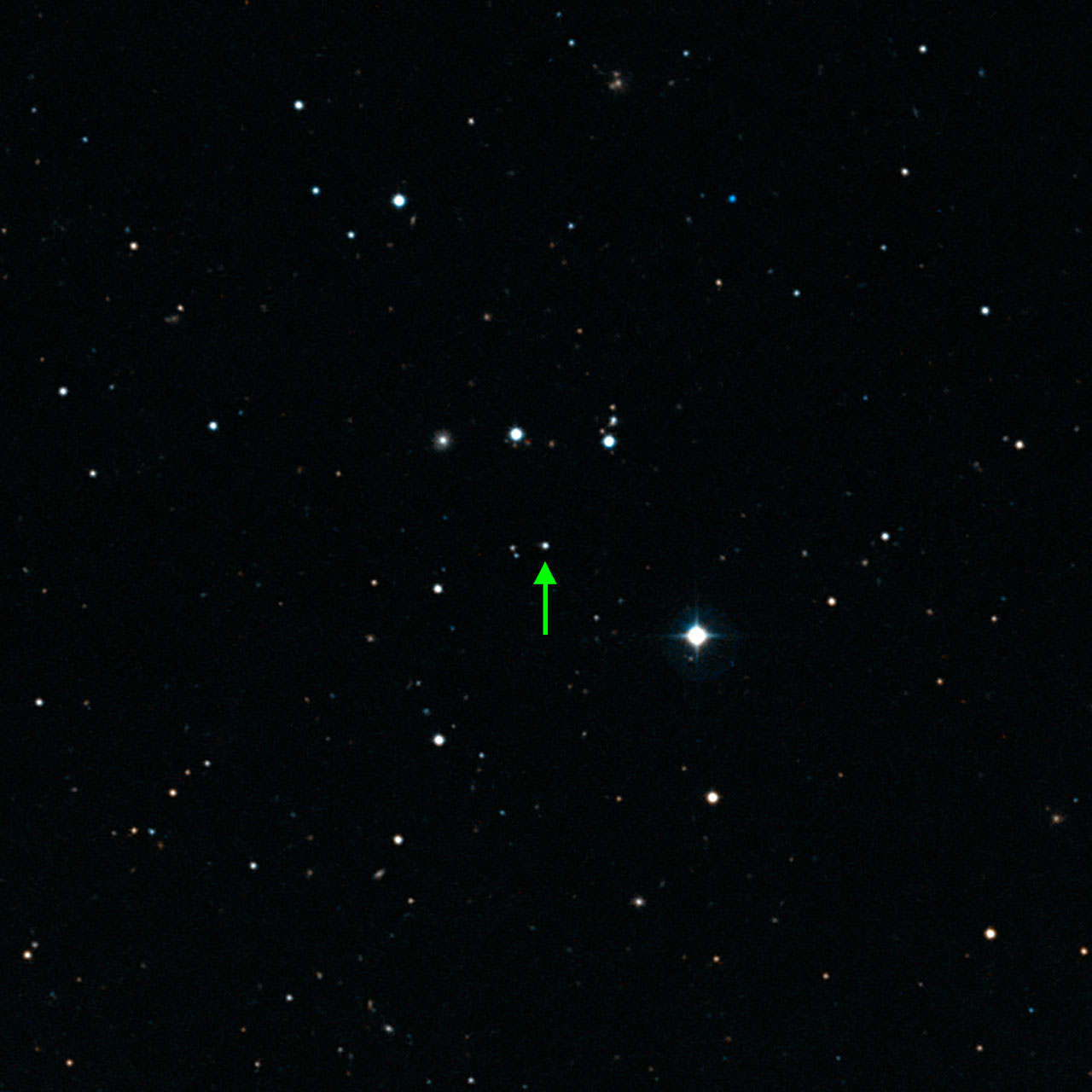
Astronomers say a newly found star should not exist and is in the “forbidden zone” of a widely accepted theory of star formation. The star, called SDSS J102915+172927, is composed almost entirely of hydrogen and helium, with only remarkably small amounts of other chemical elements in it. And how should this star be classified? We suggest either ‘easy listening’ or ‘jazz,’ as this star is certainly not heavy metal! But it may be one of the oldest stars ever found.
This faint star is located in the constellation of Leo (The Lion), and has the lowest amount of elements heavier than helium (what astronomers call “metals”) of all stars yet studied. It has a mass smaller than that of the Sun and is probably more than 13 billion years old.
“A widely accepted theory predicts that stars like this, with low mass and extremely low quantities of metals, shouldn’t exist because the clouds of material from which they formed could never have condensed,” said Elisabetta Caffau (Zentrum für Astronomie der Universität Heidelberg, Germany and Observatoire de Paris, France), lead author of the paper appearing in this week’s edition of Nature. “It was surprising to find, for the first time, a star in this ‘forbidden zone’, and it means we may have to revisit some of the star formation models.”
The team found the star with the X-shooter and UVES instruments on the Very Large Telescope. This allowed them to measure how abundant the various chemical elements were in the star. They found that the proportion of metals in SDSS J102915+172927 is more than 20,000 times smaller than that of the Sun.
“The star is faint, and so metal-poor that we could only detect the signature of one element heavier than helium — calcium — in our first observations,” said Piercarlo Bonifacio (Observatoire de Paris, France), who supervised the project. “We had to ask for additional telescope time from ESO’s Director General to study the star’s light in even more detail, and with a long exposure time, to try to find other metals.”
The prevailing theory is that hydrogen and helium were created shortly after the Big Bang, together with some lithium, while almost all other elements were formed later in stars. Supernova explosions spread the stellar material into the interstellar medium, making it richer in metals. New stars form from this enriched medium so they have higher amounts of metals in their composition than the older stars. Therefore, the proportion of metals in a star tells us how old it is.
“The star we have studied is extremely metal-poor, meaning it is very primitive. It could be one of the oldest stars ever found,” adds Lorenzo Monaco from ESO, also involved in the study.
Also very surprising was the lack of lithium in SDSS J102915+172927. Such an old star should have a composition similar to that of the Universe shortly after the Big Bang, with a few more metals in it. But the team found that the proportion of lithium in the star was at least fifty times less than expected in the material produced by the Big Bang.
“It is a mystery how the lithium that formed just after the beginning of the Universe was destroyed in this star.” Bonifacio added.
Is this star one-of-a-kind? Probably not, the researchers say. “We have identified several more candidate stars that might have metal levels similar to, or even lower than, those in SDSS J102915+172927. We are now planning to observe them with the VLT to see if this is the case,” said Caffau.
Read the team's paper (pdf file)
Source: ESO