Universe Today
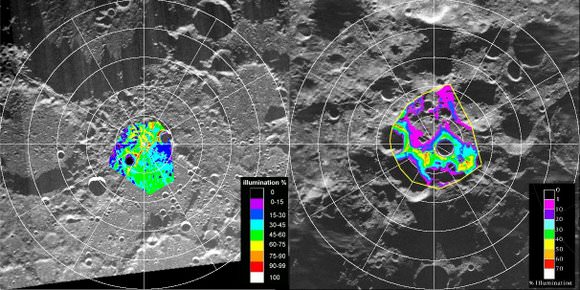
The debate has endured since the early 1960's: could there be water ice hiding in deep, dark craters near the Moon’s poles, left untouched by sunlight? Several spacecraft orbiting the moon have tried to peer into these craters to find out, but so far no definitive data has been obtained either way. But now NASA and the Indian Space Research Organization (ISRO) are looking to team up two spacecraft to try and answer the question once and for all. “When it happens, it is going to be a unique experiment and will be the first of its kind,” said Dr. Mylswamy Annadurai, project director for the Chandrayaan-I orbiter.
ISRO's Chandrayaan-I, already in lunar orbit and NASA's Lunar Reconnaissance Orbiter (LRO), scheduled to launch later this month would be maneuvered to orbit simultaneously over the lunar poles, and the data from the both spacecrafts' radar instruments would be shared and exchanged. Details of the collaboration are still being worked out, but officials hope to finalize the plans within a month.
The master plan for the experiment was developed Paul Spudis of the Lunar and Planetary Institute of Houston, who also led the team of US scientists in the Chandrayaan-I project.
“Our experiment should answer first the broad questions about the existence of lunar polar ice, its extent and purity,” Spudis wrote in his paper published in Lunar and Planetary Science journal.
As the first step, on May 19 ISRO scientists shifted Chandrayaan-I to a new orbit 200 km away, lifting it from the 100 km orbit it had been in previously.
"In contrast to some recent claims, this debate is still open and nothing has occurred in the last few years to cause participants in the debate to abandon their positions," Spudis wrote in an article for the National Space Society in 2006. "No single piece of evidence for lunar ice is decisive, but I think the preponderance of evidence indicates that water ice exists in permanently dark areas near the poles."
Finding ice in the moon’s polar region would be significant in many respects. The ice could be an abundant water source for future colonists on the moon, as well as being used for producing propellants. However, Spudis said that although polar ice is important, it is not a requirement to successfully live and work on the Moon.
Additionally, any ice on the moon would hold clues to the evolution of the solar system, as the water was likely the product of comets that crashed onto the moon over a billion years ago.
Sources: Bharat Chronicle, NSS