Universe Today
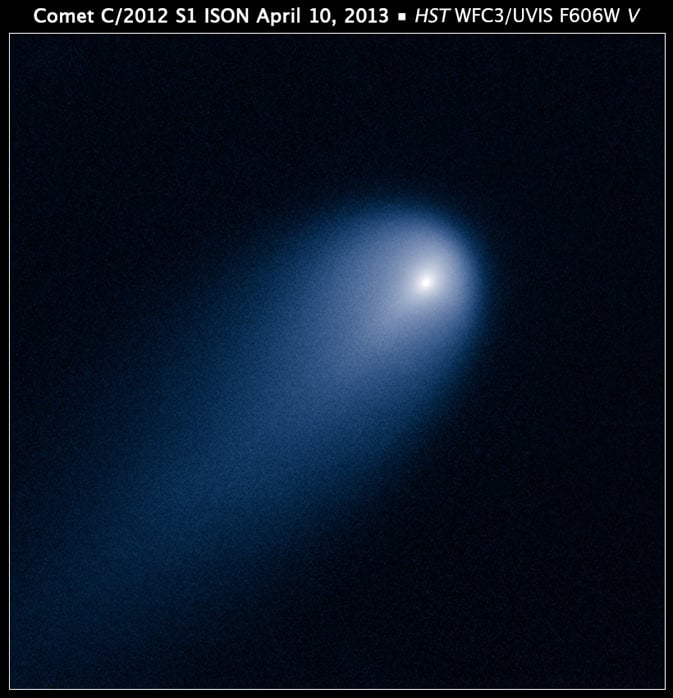
Here's our first good look at Comet (C/2012 S1) ISON. The Hubble Space Telescope captured this shot on April 10, when the comet was slightly closer than Jupiter's orbit at a distance of 634 million kilometers (394 million miles) from Earth. Later this year, this comet could become a brilliant object in the sky, perhaps 10 times brighter than Venus.
Astronomers say preliminary measurements from the Hubble images suggest that the nucleus of ISON is no larger than 4-6 km (3-4 miles) across.
The astronomers said this is remarkably small considering the high level of activity observed in the comet so far. Astronomers are using these images to measure the activity level of this comet and constrain the size of the nucleus, in order to predict the comet's activity when it will come with 1.1 million km (700,000 miles) of the Sun on November 28, 2013.
Even though Comet ISON was 620 million km from the Sun when this image was taken, the comet is already active as sunlight warms the surface and causes frozen volatiles to sublimate. A detailed analysis of the dust coma surrounding the solid, icy nucleus reveals a strong, jet blasting dust particles off the sunward-facing side of the comet's nucleus.
The comet's dusty coma, or head of the comet, is approximately 5,000 km (3,100 miles) across, or 1.2 times the width of Australia. A dust tail extends more than 92,000 km (57,000 miles), far beyond Hubble's field of view.
Comet ISON belongs to a special category of comets called sungrazers. As the comet performs a hairpin turn around the Sun in November, its ices will vaporize in the intense solar heat. Assuming it defies death by evaporation, some predict it could become as bright as the full Moon. If so, that would occur for a brief time around at perihelion (closest approach to the Sun) when the comet would only be visible in the daytime sky very close to the Sun. When safely viewed, ISON might look like a brilliant, fuzzy star in a blue sky.
More careful analysis is currently underway to improve these measurements and to predict the possible outcome of the sungrazing perihelion passage of this comet.
ISON stands for International Scientific Optical Network, a group of observatories in ten countries who have organized to detect, monitor, and track objects in space. ISON is managed by the Keldysh Institute of Applied Mathematics, part of the Russian Academy of Sciences.
Source:
NASA