Universe Today
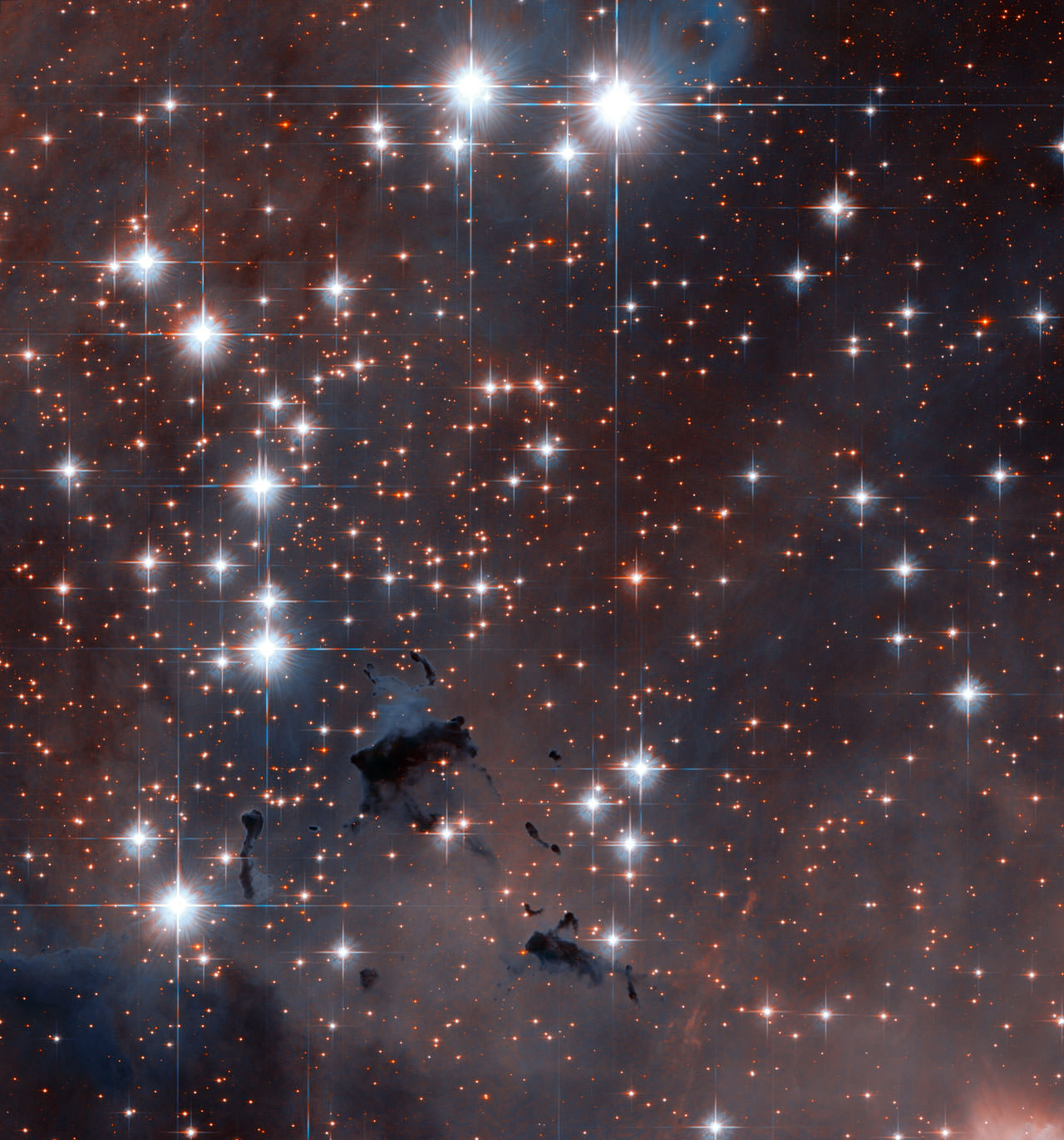
There are some stellar powerhouses inside the Eagle Nebula, and Hubble has captured a collection of these hot, blue stars. These dazzling stars are an open star cluster called NGC 6611, whose fierce ultraviolet glow make the surrounding Eagle Nebula glow brightly. But there are also areas in this image that look dark and empty. Are those areas just empty? No, they are actually very dense regions of gas and dust, which obstruct light from passing through.
Hubble astronomers say that many of these dark areas may be hiding the sites of the early stages of star formation, before the fledgling stars clear away their surroundings and burst into view. Dark nebulae, large and small, are dotted throughout the Universe. If you look up to the Milky Way with the naked eye from a dark, remote site, you can easily spot some huge dark nebulae blocking the background starlight.
This region in the Eagle Nebula formed about 5.5 million years ago and is found approximately 6,500 light-years from the Earth. The cluster and the associated nebula together are also known as Messier 16.
Astronomers refer to areas like the Eagle Nebula as HII regions. This is the scientific notation for ionised hydrogen from which the region is largely made. Extrapolating far into the future, this HII region will eventually disperse, helped along by shockwaves from supernova explosions as the more massive young stars end their brief but brilliant lives.
This picture was created from images from Hubble’s Wide Field Channel of the Advanced Camera for Surveys through the unusual combination of two near-infrared filters (F775W, colored blue, and F850LP, colored red). The image has also been subtly colorized using a ground-based image taken through more conventional filters. The Hubble exposure times were 2000 s in both cases and the field of view is about 3.2 arcminutes across.
Source: ESA/Space Telescope