Universe Today
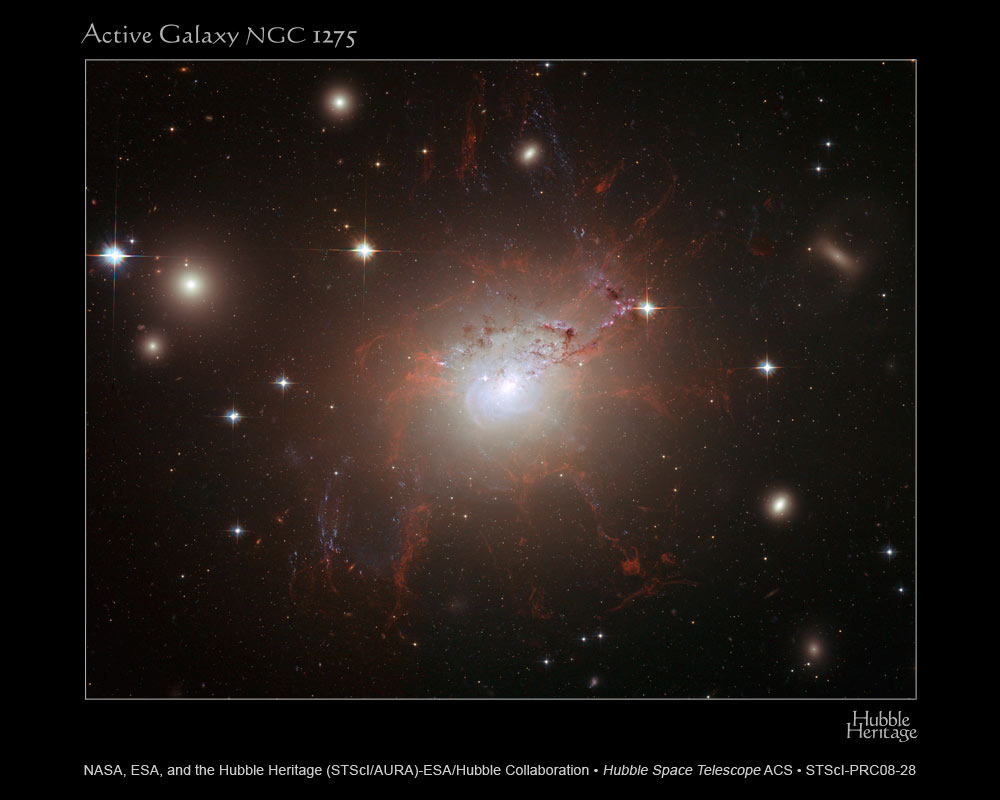
Complete with tentacles, a supermassive black hole and x-ray emitting gas, a monster of a galaxy has been found by NASA's Hubble Space Telescope, and is helping astronomers answer a long-standing puzzle. The very active galaxy NGC 1275 has giant but beautiful and delicate filaments influenced and shaped by a beastly-strong extragalactic magnetic field. But how the delicate structures such as those found in this galaxy can withstand the hostile, high-energy environment has been a mystery. But researchers say the beauty and the beast co-exist and are dependent on each other for survival.
One of the closest giant elliptical galaxies, NGC 1275 hosts a supermassive black hole. Energetic activity of gas swirling near the black hole blows bubbles of material into the surrounding galaxy cluster. Long gaseous filaments stretch out beyond the galaxy, into the multimillion-degree, X-rayâ€"emitting gas that fills the cluster. Astronomers thought these delicate filaments should have heated up, dispersed, and evaporated by now, or collapsed under their own gravity to form stars.
These filaments are the only visible-light manifestation of the intricate relationship between the central black hole and the surrounding cluster gas. They provide important clues about how giant black holes affect their surrounding environment.
Using Hubble's view, a team of astronomers led by Andy Fabian from the University of Cambridge, UK, have for the first time resolved individual threads of gas that make up the filaments. The amount of gas contained in a typical thread is around one million times the mass of our own Sun. They are only 200 light-years wide, are often very straight, and extend for up to 20,000 light-years. The filaments are formed when cold gas from the core of the galaxy is dragged out in the wake of the rising bubbles blown by the black hole.
A new study published in the August 21 Nature magazine proposes that magnetic fields hold the charged gas in place and resist the forces that would distort the filaments. This skeletal structure is strong enough to resist gravitational collapse.
"We can see that the magnetic fields are crucial for these complex filaments â€" both for their survival and for their integrity," said Fabian.
Similar networks of filaments are found around other more remote central cluster galaxies. However, they cannot be observed with comparable resolution to the view of NGC 1275. In future observations, the team will apply the understanding of NGC 1275 to interpret what they see in other, more distant galaxies.
News Source:
Hubble Site