Universe Today
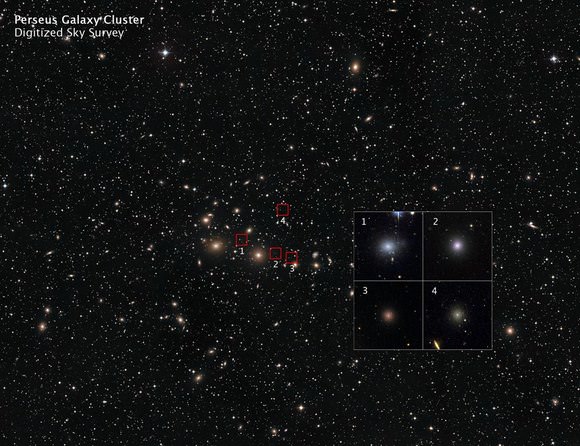
The Hubble Space Telescope has uncovered a strong new line of evidence that galaxies are embedded in halos of dark matter. By looking at the Perseus galaxy cluster, Hubble discovered a large number of small galaxies that have remained intact while larger galaxies around them are being ripped apart by the gravitational tug of other galaxies. "We were surprised to find so many dwarf galaxies in the core of this cluster that were so smooth and round and had no evidence at all of any kind of disturbance," said astronomer Christopher Conselice of the University of Nottingham, UK, and leader of the team that made the Hubble observations. "These dwarfs are very old galaxies that have been in the cluster for a long time. So if something was going to disrupt them, it would have happened by now. They must be very, very dark-matter-dominated galaxies."
Observations by Hubble's Advanced Camera for Surveys spotted 29 dwarf elliptical galaxies in the Perseus Cluster, located 250 million light-years away and one of the closest galaxy clusters to Earth. Of these galaxies, 17 are new discoveries.
Cosmologists estimate that dark matter comprises 23 percent of all energy in the cosmos. An equally mysterious “dark energy,” which drives galaxies apart, is thought to take up another 73 percent or so. The ordinary matter that we can see is believed to represent only four percent of the total mass of the Universe.
Because dark matter cannot be seen, astronomers detected its presence through indirect evidence. The most common method is by measuring the velocities of individual stars or groups of stars as they move randomly in the galaxy or as they rotate around the galaxy. The Perseus Cluster is too far away for telescopes to resolve individual stars and measure their motions. So Conselice and his team derived a new technique for uncovering dark matter in these dwarf galaxies by determining the minimum additional mass contribution from dark matter that the dwarfs must have to protect them from being disrupted by the strong, tidal pull of gravity from larger galaxies.
The dwarf galaxies may have an even higher amount of dark matter than spiral galaxies. "With these results, we cannot say whether the dark matter content of the dwarfs is higher than in the Milky Way Galaxy," Conselice said. "Although, the fact that spiral galaxies are destroyed in clusters, while the dwarfs are not, suggests that this is indeed the case."
But these new images provide evidence that the undisturbed galaxies are enshrouded by a "cushion" of dark matter that protects them from being torn apart.
Source: HubbleSite